
Basement Leak Repair in Toronto — 2026 Guide
Toronto's clay soil and aging housing stock make basement leaks one of the most common — and most urgent — home repair needs in the city.
Written by Pavel Vysotckii
BCIN-certified building designer & Quantity Surveyor · Updated June 2026
Warning Signs Your Toronto Basement Needs Repair
If you notice any of these signs in your Toronto home, it's time for a professional leak assessment.
Water Stains or Puddles
Visible water marks on walls or pooling water on the floor after rain. Active water infiltration requires immediate attention to prevent mold and structural damage.
Musty or Damp Smell
A persistent musty odour indicates hidden moisture and potential mold growth. Even without visible water, this smell means your basement has a moisture problem.
White Mineral Deposits (Efflorescence)
White, chalky deposits on concrete or block walls — salt residue left when water passes through the foundation and evaporates. Proof that water is moving through your walls.
Peeling Paint or Bubbling Walls
Paint peeling, wallpaper bubbling, or drywall softening — all signs of moisture trapped behind the surface. The wall is absorbing water from the foundation.
Foundation Cracks
Horizontal cracks suggest hydrostatic pressure. Vertical cracks may indicate settling. Stair-step cracks in block walls signal structural movement. All can admit water.
Visible Mold Growth
Black, green, or white mold colonies on walls, floors, or stored items. Mold requires moisture to grow — its presence confirms an active water problem that must be fixed.
Sticking Doors or Windows
Doors and windows that suddenly become difficult to open or close may indicate foundation movement caused by water-saturated soil shifting against your walls.
Insects or Pests
Silverfish, centipedes, earwigs, and other moisture-loving insects in the basement indicate damp conditions that attract pests seeking humid environments.
How Professionals Diagnose Basement Leaks
A proper diagnosis determines the most effective and cost-efficient repair method for your Toronto home.
Identify the Water Source
Determine whether water is entering through walls, floor, floor-wall joint, or window wells. Use the foil test: tape a 12" square of aluminum foil to the wall. After 24 hours, check if moisture is on the room side (condensation) or wall side (infiltration).
Inspect Exterior Drainage
Walk around the outside during or after rain. Check if gutters are overflowing, downspouts discharge too close to the foundation, or the grading slopes toward the house. Most basement leaks start with poor exterior water management.
Assess Foundation Condition
Examine foundation walls for cracks, deterioration, or bowing. Measure crack width — hairline cracks (<1/16") are cosmetic, but wider cracks may be structural. Note if cracks are horizontal (hydrostatic pressure) or vertical (settling).
Basement Leak Repair Methods — Comparison
Different leak problems require different solutions. Here's how the main repair methods compare for Toronto homes.
| Method | Best For | Price (Toronto) | Timeline | Effectiveness |
|---|---|---|---|---|
| Crack Injection (Epoxy/Polyurethane) | Single cracks in poured concrete walls | $250–$640 / per linear foot | 1–2 hours per crack | 95%+ for individual cracks |
| Interior Drainage System (Weeping Tile) | Widespread water seepage, floor-wall joint leaks | $70–$240 / per linear foot | 3–5 days | Highly effective for managing hydrostatic pressure |
| Exterior Waterproofing | Severe water infiltration, old or deteriorated foundation | $100–$300 / per linear foot | 5–10 days | 99%+ — the gold standard |
| Sump Pump Installation | High water table, recurring flooding | $600–$3,500 / per unit | 1–2 days | 90%+ when combined with drainage |
| Backwater Valve Installation | Sewer backup prevention during heavy storms | $1,800–$3,200 / per unit | 1 day | 99% for sewer backup prevention |
| Interior Wall Membrane System | Block wall seepage, general dampness | $40–$80 / per linear foot | 2–3 days | 85%+ for managing wall moisture |
Basement Leak Repair Methods — How They Work
Step-by-step process for each repair method with Toronto-adjusted pricing.
Crack Injection (Epoxy/Polyurethane)
Single cracks in poured concrete walls
Process
- 1Clean and prepare the crack surface
- 2Install injection ports along the crack length
- 3Inject epoxy (structural) or polyurethane (flexible) resin
- 4Resin expands to fill the full depth of the crack
- 5Remove ports and smooth the surface
Price in Toronto
$250–$640
Timeline
1–2 hours per crack
Interior Drainage System (Weeping Tile)
Widespread water seepage, floor-wall joint leaks
Process
- 1Break and remove concrete floor along the perimeter (12–18 inches)
- 2Excavate trench to below footing level
- 3Install perforated drainage pipe (weeping tile) in gravel bed
- 4Connect drainage to sump pit with pump
- 5Apply dimpled membrane on interior wall face
- 6Pour new concrete floor over the drainage channel
Price in Toronto
$70–$240
Timeline
3–5 days
Exterior Waterproofing
Severe water infiltration, old or deteriorated foundation
Process
- 1Excavate soil around the foundation to the footing
- 2Clean and inspect the foundation wall
- 3Apply waterproof membrane (rubberized asphalt or spray-applied)
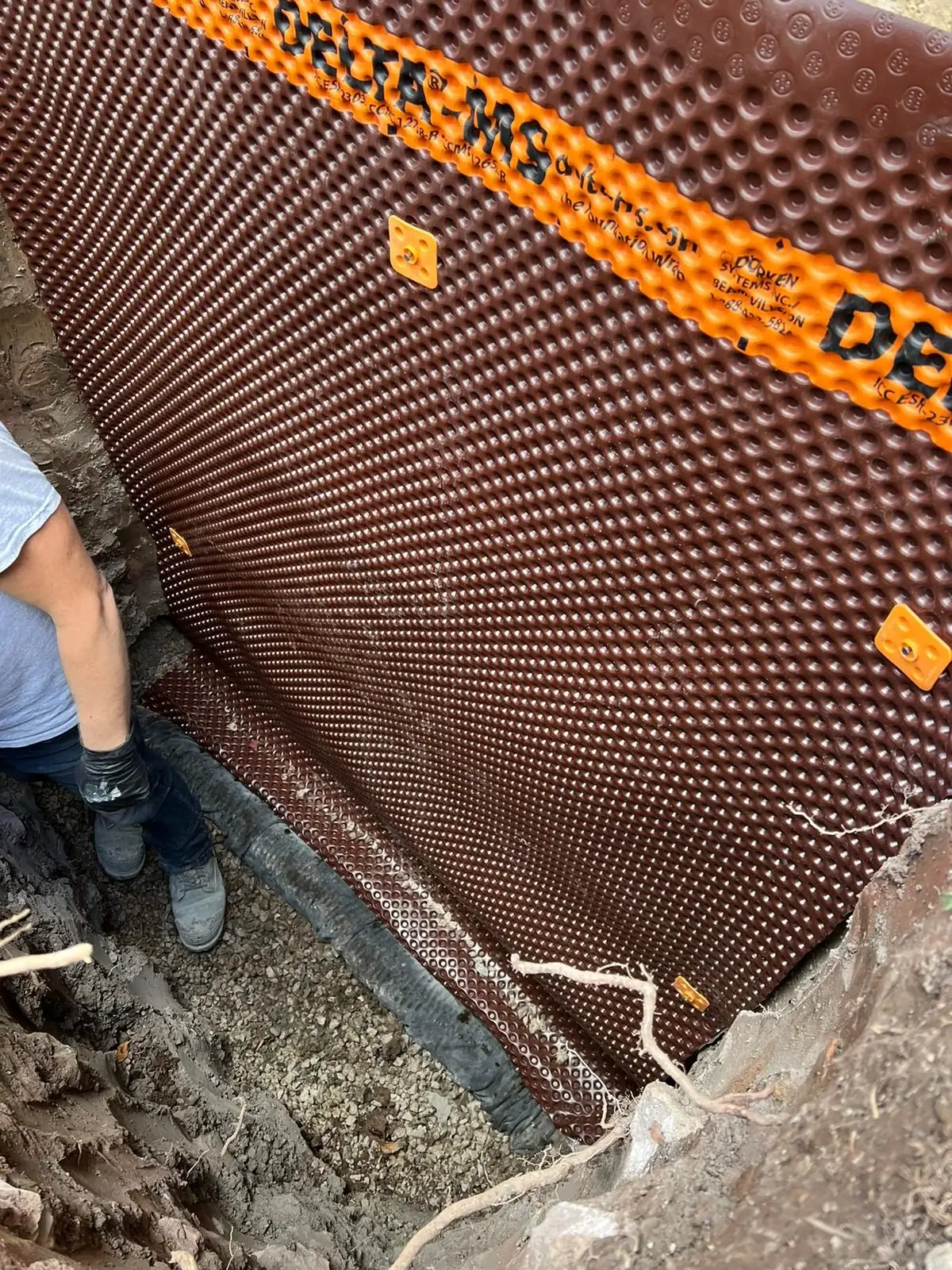
- 4Install drainage board and filter fabric
- 5Replace or install exterior weeping tile
- 6Backfill with clean gravel and restore grade
Price in Toronto
$100–$300
Timeline
5–10 days
Sump Pump Installation
High water table, recurring flooding
Process
- 1Break concrete floor and excavate sump pit (24" × 24" × 30" deep)
- 2Install sump liner with gravel base
- 3Place primary pump (1/3 HP minimum for residential)
- 4Install check valve and discharge pipe
- 5Route discharge away from foundation (minimum 6 feet)
- 6Optional: install battery backup pump for power outages
Price in Toronto
$600–$3,500
Timeline
1–2 days
Backwater Valve Installation
Sewer backup prevention during heavy storms
Process
- 1Locate the main sewer line inside the basement
- 2Break concrete floor to expose the sewer pipe
- 3Cut the pipe and install the backwater valve
- 4Test valve operation and ensure proper seal
- 5Patch concrete and clean up
- 6Schedule municipal inspection (required for rebates)
Price in Toronto
$1,800–$3,200
Timeline
1 day
Interior Wall Membrane System
Block wall seepage, general dampness
Process
- 1Clean and prepare interior wall surface
- 2Install dimpled drainage membrane on wall face
- 3Seal membrane edges and penetrations
- 4Route collected water to interior drain or sump
- 5Optional: install dehumidifier for residual moisture
Price in Toronto
$40–$80
Timeline
2–3 days
Why Toronto Homes Get Basement Leaks
Toronto sits on heavy clay soil that retains moisture and expands when wet, creating hydrostatic pressure against foundation walls. Pre-1960s homes in areas like the Danforth, Leslieville, High Park, and the Beaches are especially vulnerable due to aging weeping tile, deteriorating foundation waterproofing, and original clay sewer connections. Some neighbourhoods carry extra risk: Riverdale's low-lying streets drain toward the Don Valley on the city's combined sewer network, so heavy storms can push water back toward basements faster than the system can carry it away. The Annex's century-old brick homes often still rely on original clay weeping tile and tar-based waterproofing that has long passed its service life. Rockcliffe-Smythe sits in the Black Creek flood plain, where surface runoff and an overloaded sewer system make it one of the most flood-prone pockets in the city.
Common Causes in Toronto
- Heavy clay soil retaining moisture and creating hydrostatic pressure
- Aging weeping tile (pre-1970s homes) becoming clogged or collapsed
- Original tar-based waterproofing deteriorating after 30+ years
- Combined sewer system causing backup during heavy rainfall
- Poor grading and drainage around older homes
When Toronto Basements Are Most at Risk
Seasonal Leak Risk
Toronto's peak leak season runs from March to May during spring snowmelt, and again in September–October during fall storms. The spring thaw is particularly risky — frozen ground prevents meltwater from absorbing into the soil, directing it against foundations. Summer thunderstorms (June–August) can overwhelm the city's combined sewer system, causing sewer backup in low-lying neighbourhoods.
Spring
HighestSummer
HighFall
ModerateWinter
LowHow to Prevent Basement Leaks in Toronto
Proactive maintenance can catch small problems before they become costly repairs.
Exterior Drainage
Clean gutters and downspouts
Twice yearly (spring & fall)
Extend downspouts 6+ feet from foundation
Check annually
Maintain positive grading away from house
Check annually
Clear window wells of debris
Quarterly
Interior Inspection
Check for new cracks or crack growth
Monthly
Look for water stains or efflorescence
After heavy rain
Monitor basement humidity (keep below 60%)
Weekly in summer
Inspect stored items for mold or dampness
Quarterly
Sump Pump Maintenance
Test sump pump by pouring water into pit
Quarterly
Test battery backup system
Every 6 months
Clean sump pit of debris
Annually
Replace sump pump
Every 7–10 years
Seasonal Preparation
Inspect and repair caulking around windows and vents
Before winter
Ensure outdoor taps are winterized
Before first frost
Clear snow and ice from foundation perimeter
During winter thaw
Run dehumidifier during humid months
May–September
GTA Basement Leak Prevention Rebates
Many GTA municipalities offer rebates for basement leak prevention. Here are programs available near Toronto.
Your Toronto Rebate
Toronto offers up to $6,650 through the Basement Flooding Protection Subsidy for work completed on or after November 12, 2025: backwater valve (up to $1,600 per device, max 2 devices), sump pump (up to $2,250 plus $300 for a battery backup), foundation drain pipe severance and capping (up to $400), and plumbing investigation (up to $500). Apply through 311 Toronto.
City of Toronto — Up to $6,650
Backwater valve (up to $1,600 per device, max 2 devices), sump pump (up to $2,250 plus $300 for a battery backup), foundation drain pipe severance and capping (up to $400), plumbing investigation (up to $500). Maximum applies to work completed on or after November 12, 2025. Apply through 311 Toronto.
Region of Peel — Up to $2,800
Backwater valve installation subsidy. Covers Mississauga, Brampton, and Caledon. Apply through Region of Peel.
City of Hamilton — Up to $2,750
Backwater valve and sump pump through the Protective Plumbing Program. Apply through Hamilton Water Division.
York Region — Varies
Basement flooding prevention subsidies — varies by municipality (Vaughan, Markham, Richmond Hill, Aurora). Contact your local municipality.
Durham Region — Varies
Periodic backwater valve and sump pump subsidies for Ajax, Pickering, Whitby, Oshawa. Contact Durham Region.
Halton Region — Varies
Stormwater management programs for Oakville, Burlington, Milton. Contact Halton Region or your municipality.
Basement Leak Repair Prices in Toronto
City-adjusted pricing based on Toronto labour and material rates.
| Method | Price Range | Unit |
|---|---|---|
| Crack Injection (Epoxy/Polyurethane) | $250 – $640 | per linear foot |
| Interior Drainage System (Weeping Tile) | $70 – $240 | per linear foot |
| Exterior Waterproofing | $100 – $300 | per linear foot |
| Sump Pump Installation | $600 – $3,500 | per unit |
| Backwater Valve Installation | $1,800 – $3,200 | per unit |
| Interior Wall Membrane System | $40 – $80 | per linear foot |
Prices are estimates based on typical GTA projects. Actual costs depend on home size, leak severity, soil conditions, and scope. Get a personalized price check →
Basement Leak Repair FAQ — Toronto
Why does my Toronto basement leak after rain?
Toronto's clay soil retains water and creates hydrostatic pressure against your foundation. When it rains, water saturates the soil around your home and pushes through cracks, the floor-wall joint, or deteriorated waterproofing.
How much does basement leak repair cost in Toronto?
Costs range from $250–$640 per linear foot for crack injection to $100–$300 per linear foot for exterior waterproofing. A typical Toronto home costs $4,000–$8,000 for interior solutions or $15,000–$35,000 for exterior waterproofing.
Do I need interior or exterior waterproofing?
Interior solutions (drainage + sump pump) manage water that enters. Exterior waterproofing stops water from reaching the foundation. For best results on older Toronto homes, a combination approach is often recommended.
How long does basement leak repair take?
Crack injection: 1–2 hours. Interior drainage system: 3–5 days. Exterior waterproofing: 5–10 days. Most repairs cause minimal disruption to daily life.
Will my Toronto home insurance cover a basement leak?
Most policies cover sudden water damage (burst pipe) but not gradual seepage or foundation leaks. Sewer backup coverage is usually an add-on. Installing a backwater valve may reduce your premium.
What rebates are available in Toronto?
The City of Toronto's Basement Flooding Protection Subsidy covers up to $6,650 total for work completed on or after November 12, 2025: backwater valves (up to $1,600 per device, max 2 devices), sump pumps (up to $2,250 plus $300 for a battery backup), foundation drain pipe severance and capping (up to $400), and a plumbing investigation (up to $500). A plumbing permit is required to qualify.
Can I fix a basement leak myself?
Minor efflorescence can be cleaned, and exterior grading can be improved as DIY projects. However, crack injection, drainage systems, and waterproofing require professional equipment and expertise for lasting results.
How do I prevent basement leaks in Toronto?
Maintain gutters and downspouts, ensure positive grading, test your sump pump quarterly, install a backwater valve, and run a dehumidifier in summer. Address small cracks before they grow.
Is basement waterproofing worth it in Toronto?
Absolutely. Untreated water damage leads to mold, structural deterioration, and lost property value. Waterproofing protects a home worth $800K–$2M+ for a fraction of that investment.
How do I find a reliable leak repair contractor in Toronto?
Look for a licensed, insured waterproofing specialist with a track record of foundation work. We're licensed under the OBC, insured, and WSIB covered — you approve each fixed milestone before paying, and progress photos land in our live client app. Book a free walkthrough to start.
Basement Leak Repair in Nearby Cities
Professional leak repair services throughout the Greater Toronto Area
Fix Your Basement Leak in Toronto
Book a free walkthrough with our crew. Fixed milestone pricing you approve stage by stage, a live client app with daily photos and inspection reports, and a written warranty on the work.