
Best Waterproofing Companies in Toronto
Protect Your Toronto Home From Water Damage. Toronto sits on heavy clay soil that retains water and creates hydrostatic pressure against basement walls. With homes dating back over 100 years in neighborhoods like The Annex, Leslieville, and East York, aging foundations are a leading cause of basement leaks.
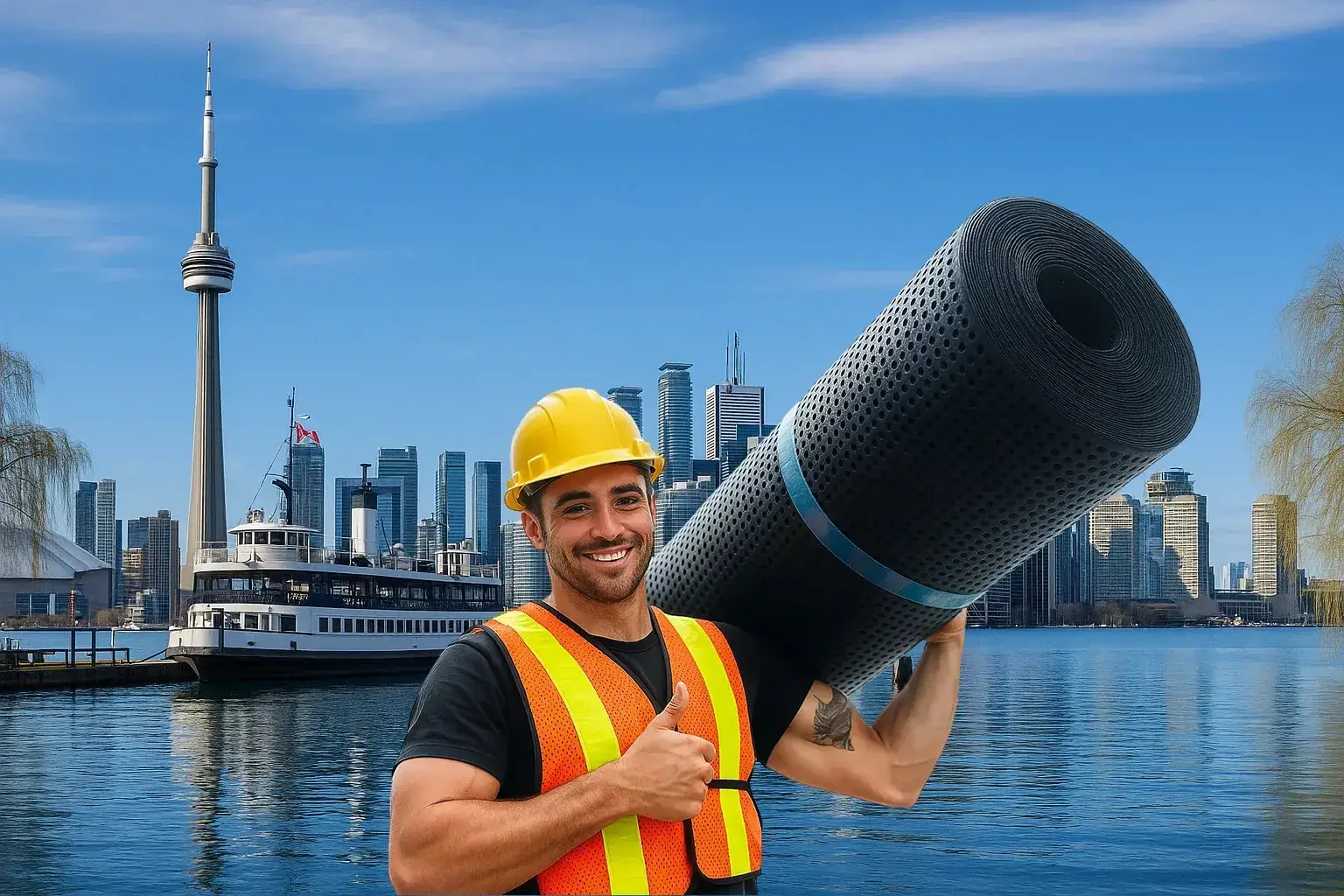
What Is Basement Waterproofing?
Basement waterproofing is the process of preventing water from entering your home's foundation and basement space. It involves a combination of techniques — drainage systems, waterproof membranes, sump pumps, and foundation crack repair — designed to keep your basement dry and structurally sound.
Water enters basements through three main pathways: through cracks in foundation walls, through the floor-wall joint (called the cove joint), and up through the concrete floor slab itself. The approach to waterproofing depends on which pathway is causing the problem and whether the solution addresses water from the exterior (positive side) or interior (negative side).
In the GTA, most homes sit on heavy clay soil that retains water and creates hydrostatic pressure against foundation walls. This pressure, combined with Ontario's freeze-thaw cycles, means virtually every home will eventually need some form of waterproofing attention.
Warning Signs Your Basement Needs Waterproofing
If you notice any of these signs in your Toronto home, it's time for a professional waterproofing assessment.
Water Stains or Puddles
Visible water marks on basement walls or pooling water on the floor after rain or snowmelt. This is the most obvious sign of active water infiltration.
Musty or Damp Smell
A persistent musty odor indicates moisture is present even when you can't see water. Mold and mildew thrive in damp environments and produce this characteristic smell.
White Mineral Deposits (Efflorescence)
White, chalky deposits on concrete or block walls. This is salt left behind when water passes through the foundation and evaporates — proof that water is moving through the wall.
Peeling Paint or Bubbling Walls
Paint peeling off basement walls, wallpaper bubbling, or drywall becoming soft or crumbly. Moisture behind the wall surface causes these visible failures.
Foundation Cracks
Horizontal, vertical, or stair-step cracks in foundation walls. Vertical cracks may indicate settling; horizontal cracks suggest hydrostatic pressure from saturated soil.
Visible Mold Growth
Black, green, or white mold colonies on walls, floors, or stored items. Mold needs moisture to grow — its presence means your basement has a water problem.
Sticking Doors or Windows
Doors and windows that suddenly become hard to open or close. This can indicate foundation movement caused by water-related soil shifting.
Insects or Pests
Increased insects (silverfish, centipedes, earwigs) or rodents in the basement. These pests are attracted to damp, dark environments.
Why Waterproof Your Basement?
Waterproofing is one of the highest-ROI home improvements for Toronto homeowners.
Protect Your Investment
A wet basement reduces your home's value by 10-25%. Waterproofing protects a property worth $500,000 – $2,000,000+ for a fraction of that cost.
Create a Legal Basement Apartment
Ontario building code requires habitable basement units to be free of water infiltration. Waterproofing is step one before any basement apartment conversion.
Eliminate Health Hazards
Damp basements breed mold, which causes respiratory problems, allergies, and asthma — especially dangerous for children and the elderly.
Reclaim Living Space
A dry basement becomes a family room, home office, gym, or guest suite — adding usable square footage without an addition.
Qualify for Insurance Coverage
Many insurers require or incentivize sump pumps and backwater valves. Waterproofing can lower your home insurance premiums.
Increase Resale Value
Buyers pay a premium for homes with documented waterproofing. Dated project photos and a written warranty add $15,000 – $30,000 in perceived value.
Featured Waterproofing Pro in Toronto
Licensed, insured, WSIB-covered contractor serving Toronto and the Greater Toronto Area
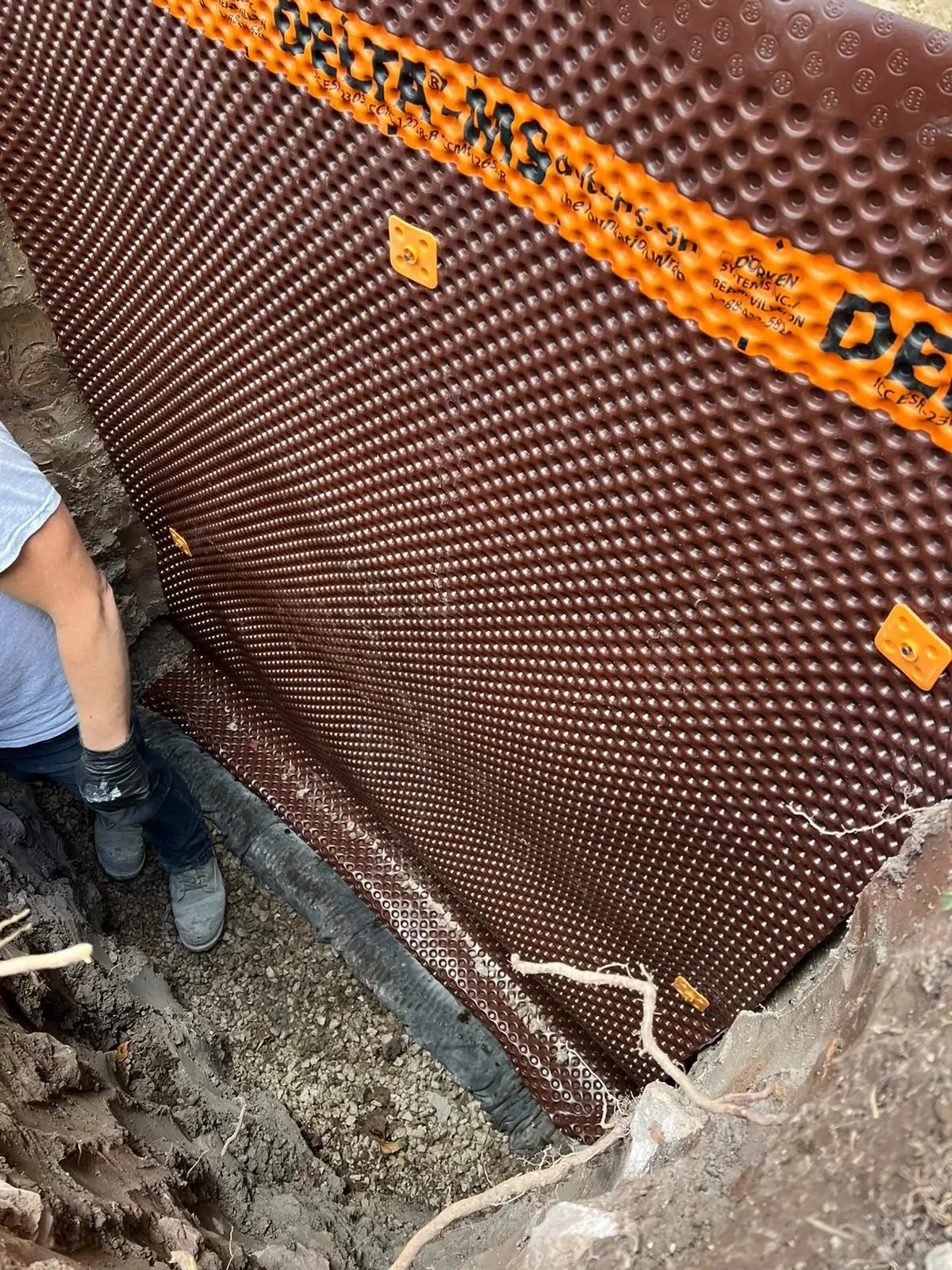
DrySpace Waterproofing
Waterproofing & Foundation Repair
Professional waterproofing contractor serving Toronto and the GTA. Interior & exterior waterproofing, sump pumps, backwater valves, and foundation crack repair. Every stage documented with daily photos in the live client app.
Interior vs. Exterior Waterproofing: Which Is Right for You?
Understanding the difference helps you choose the right approach for your Toronto home.
| Factor | Interior | Exterior |
|---|---|---|
| How it works | Captures water that enters and redirects it to a sump pump | Prevents water from reaching the foundation wall |
| Effectiveness | Manages water — doesn't stop it from entering the wall | Stops water at the source — gold standard approach |
| Cost (per wall) | $5,000 – $10,000 | $5,000 – $12,000 |
| Disruption | Minimal — work done inside, no landscaping damage | Significant — excavation disrupts landscaping, driveways, decks |
| Best for | Homes with finished exteriors, limited access, or budget constraints | Homes with accessible exteriors and active wall leaks |
| System lifespan | 15-20 years (pump components need replacement) | 25-30+ years for membrane system |
| Timeline | 2-4 days | 3-7 days per wall |
How We Waterproof Your Toronto Home
Five core waterproofing services with step-by-step process details and Toronto pricing
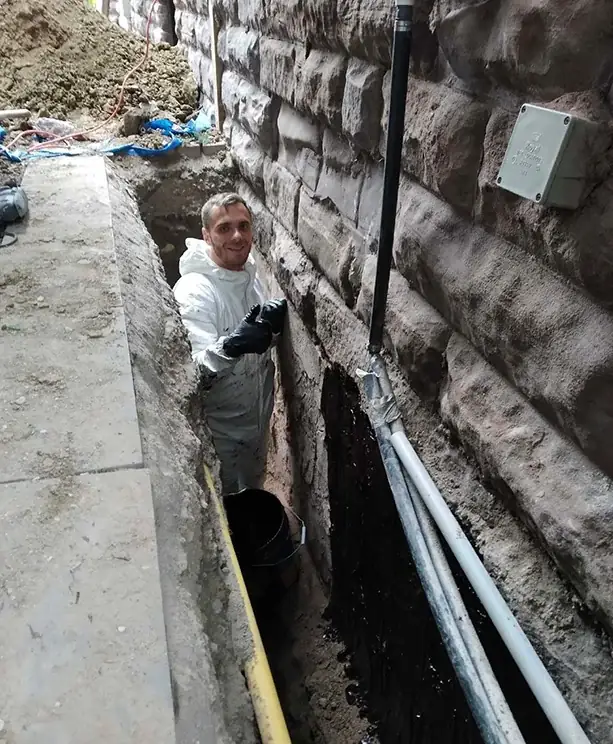
Exterior Waterproofing
Full excavation around the foundation to expose the wall, followed by cleaning, crack repair, application of a rubberized membrane, dimpled drainage board, and new weeping tile. This is the gold standard for stopping water infiltration at the source.
Process
- 1Excavate soil to the base of the footing
- 2Clean and inspect the foundation wall
- 3Repair all cracks with hydraulic cement
- 4Apply rubberized waterproofing membrane
- 5Install dimpled drainage board over membrane
- 6Lay new weeping tile wrapped in filter fabric
- 7Backfill with clear gravel and native soil
- 8Re-grade surface for proper drainage away from home
Price in Toronto
$5,000 – $12,000
Timeline
3 – 7 days per wall
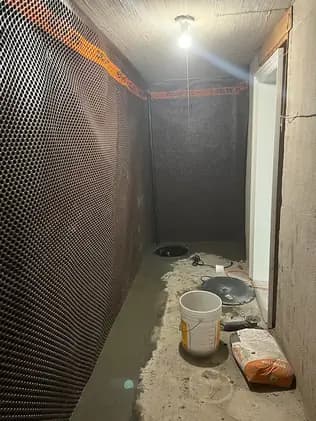
Interior Waterproofing
An interior French drain system that captures water entering through the floor-wall joint and channels it to a sump pit. Ideal when exterior excavation is not feasible due to driveways, decks, or landscaping.
Process
- 1Break concrete floor along the perimeter (12-inch strip)
- 2Excavate a trench below the slab
- 3Install perforated drain pipe bedded in gravel
- 4Connect drain to sump pit with check valve
- 5Apply vapor barrier on interior wall
- 6Pour new concrete to close the trench
- 7Install sump pump with battery backup
Price in Toronto
$5,000 – $10,000
Timeline
2 – 4 days
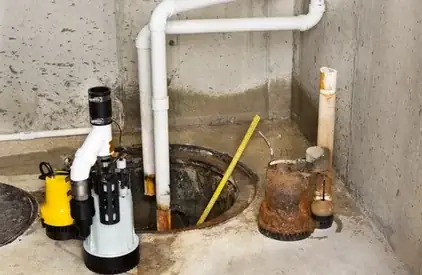
Sump Pump Installation
Professional sump pump installation with a primary pump and battery-backup unit. Includes a properly sized pit, check valve, and exterior discharge line routed away from the foundation.
Process
- 1Cut and remove concrete slab at pump location
- 2Excavate sump pit (18" x 24" minimum)
- 3Install pit liner with gravel base
- 4Set primary submersible pump with float switch
- 5Install battery backup pump (12V marine battery)
- 6Connect discharge pipe through rim joist
- 7Route discharge line 6+ feet from foundation
- 8Test both primary and backup systems
Price in Toronto
$800 – $3,500
Timeline
1 – 2 days

Backwater Valve Installation
A backwater valve prevents sewer backups during heavy storms by automatically closing when water flows backward through the sewer line. Many GTA municipalities offer rebates for installation — the City of Toronto subsidizes up to $1,600 per device (max 2 devices).
Process
- 1Locate main sewer line and determine valve position
- 2Break concrete floor over sewer pipe
- 3Cut existing pipe and fit backwater valve
- 4Install access lid flush with floor
- 5Pour new concrete and finish patch
- 6Test valve operation and flow direction
- 7Complete rebate application paperwork
Price in Toronto
$2,000 – $5,000
Timeline
1 day
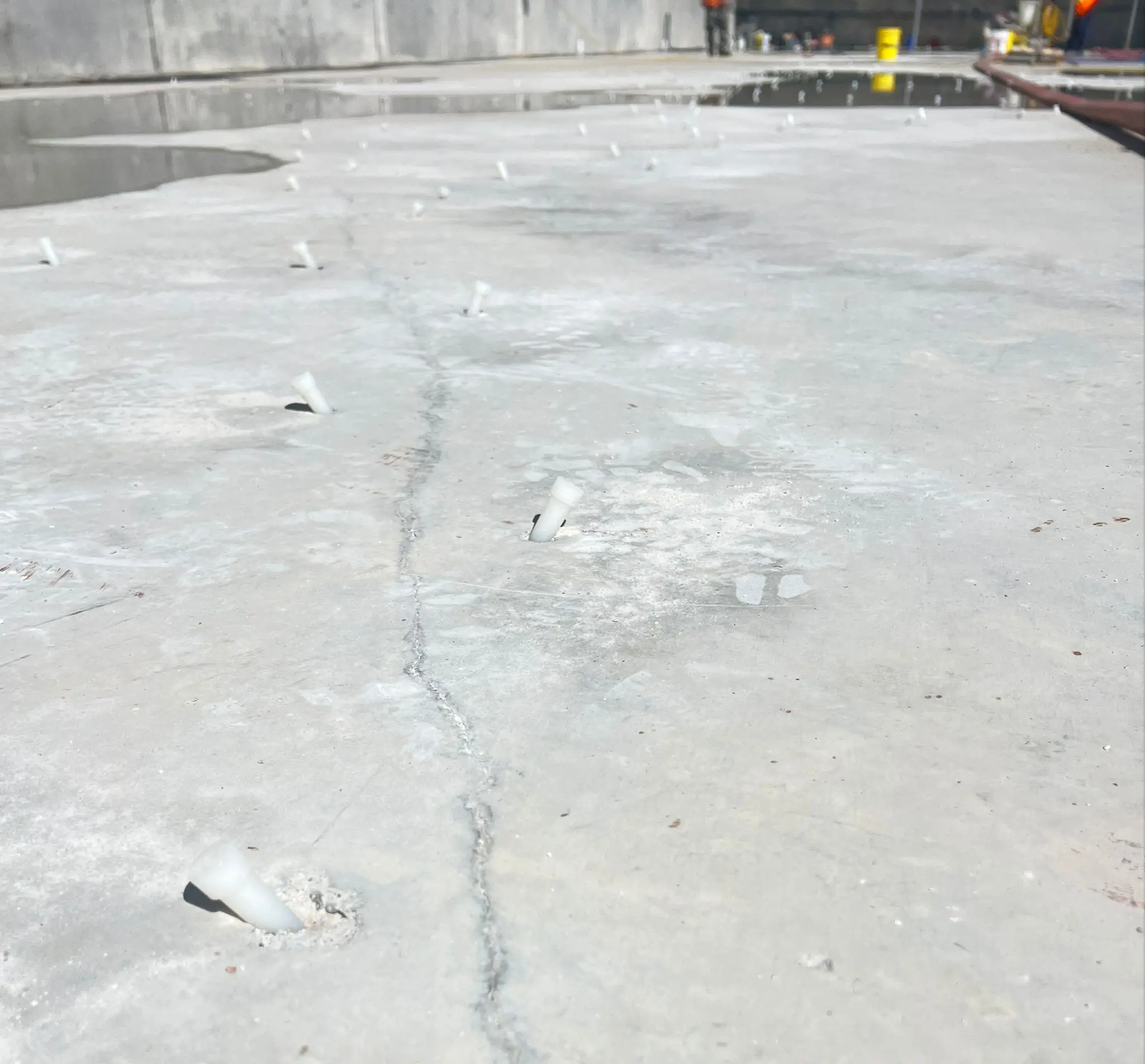
Foundation Crack Repair
Structural and non-structural crack repair using epoxy or polyurethane injection from the interior, or excavation and membrane patching from the exterior. The method depends on the crack type, width, and whether it is actively leaking.
Process
- 1Inspect crack width, depth, and pattern
- 2Clean crack and remove loose material
- 3Install injection ports at 8-12 inch intervals
- 4Seal surface between ports with epoxy paste
- 5Inject crack with epoxy (structural) or polyurethane (waterproofing)
- 6Allow cure time (24-48 hours for epoxy)
- 7Remove surface seal and ports
- 8Optional: apply exterior membrane if excavated
Price in Toronto
$500 – $1,500
Timeline
2 – 4 hours per crack
Why Toronto Homes Need Waterproofing
Toronto sits on heavy clay soil that retains water and creates hydrostatic pressure against basement walls. With homes dating back over 100 years in neighborhoods like The Annex, Leslieville, and East York, aging foundations are a leading cause of basement leaks. The city's combined sewer system also makes basements vulnerable to sewer backups during major storms.
Clay Soil
Toronto's dense clay retains water and puts constant pressure on foundation walls, especially after spring thaw.
Aging Homes
Over 40% of Toronto homes were built before 1980, with original waterproofing that has long since deteriorated.
Storm Surge Risk
Toronto's combined sewer system means heavy rainfall can push sewage back up through basement floor drains.
Freeze-Thaw Cycles
Ontario's winters cause repeated expansion and contraction in concrete, opening hairline cracks over time.
Common Basement Issues in Toronto
- Clay soil creating hydrostatic pressure against foundations
- Pre-1950 rubble stone foundations with no waterproofing membrane
- Combined sewer system causing backup during storms
- Aging weeping tile (clay tile) that has collapsed or clogged
- Frost-heave cracking in foundations from Ontario freeze-thaw cycles
- Rising water table in lakefront and ravine-adjacent neighborhoods
Toronto Neighborhoods We Serve
Waterproofing Permits & Requirements in Ontario
Not all waterproofing work requires a permit, but some does. Here's what you need to know:
Interior crack injection (epoxy or polyurethane)No Permit
Minor repair — no permit needed
Sump pump replacement (like-for-like)No Permit
No permit for replacing existing equipment
New sump pump installation (where none existed)Permit Required
Plumbing permit may be required for new discharge line
Backwater valve installationPermit Required
Plumbing permit required — needed for rebate applications
Exterior excavation deeper than 1.2 metresPermit Required
Excavation permit or building permit depending on municipality
Interior weeping tile and drainage systemPermit Required
May require plumbing permit for sump and discharge
Any work affecting municipal sewer connectionPermit Required
Always requires municipal permit and inspection
Your waterproofing contractor should handle all permit applications. We manage the permit paperwork ourselves and document every approval in your project record in the live client app.
GTA Waterproofing Rebates & Subsidies
Many GTA municipalities offer rebates for waterproofing improvements. Here are the programs available near Toronto.
Your Toronto Rebate
The City of Toronto Basement Flooding Protection Subsidy covers up to $6,650 total for eligible work completed on or after November 12, 2025: backwater valve (up to $1,600 per device, max 2 devices), sump pump (up to $2,250, plus $300 for battery backup), foundation drain pipe severance and capping (up to $400), and plumbing investigation (up to $500). Apply through toronto.ca.
City of Toronto — Basement Flooding Protection Subsidy
- Backwater valve: up to $1,600 per device (max 2 devices)
- Sump pump: up to $2,250, plus $300 for battery backup
- Foundation drain pipe severance & capping: up to $400
- Plumbing investigation: up to $500
Total: Up to $6,650 total for work on/after Nov 12, 2025 · Apply through toronto.ca
Region of Peel — Backwater Valve Subsidy
- Backwater valve installation: up to $2,800
Total: Up to $2,800 per property · Apply through Region of Peel
City of Hamilton — Protective Plumbing Program
- Backwater valve + sump pump: up to $2,750
Total: Up to $2,750 per property · Apply through Hamilton Water Division
York Region — Basement Flooding Prevention
- Backwater valve subsidy: varies by municipality
Total: Varies — check with your local municipality · Contact your municipality
Durham Region — Basement Flooding Protection
- Backwater valve + sump pump subsidies available periodically
Total: Varies by program cycle · Contact Durham Region
Halton Region — Stormwater Management
- Periodic basement flooding prevention programs
Total: Varies by program · Contact Halton Region or your local municipality
Waterproofing Prices in Toronto
City-adjusted pricing based on Toronto labour and material rates.
| Service | Price Range | Timeline |
|---|---|---|
| Exterior Waterproofing | $5,000 – $12,000 | 3 – 7 days per wall |
| Interior Waterproofing | $5,000 – $10,000 | 2 – 4 days |
| Sump Pump Installation | $800 – $3,500 | 1 – 2 days |
| Backwater Valve Installation | $2,000 – $5,000 | 1 day |
| Foundation Crack Repair | $500 – $1,500 | 2 – 4 hours per crack |
Updated June 2026. Prices are estimates based on typical GTA projects. Actual costs depend on home size, access, soil conditions, and scope. See detailed cost breakdown →
How Toronto's Established Waterproofing Companies Compare
Most “best waterproofing” lists are written by the companies that appear on them. Here is a factual look at the established names you'll find in this search — and where we honestly fit.
Methodology: compiled June 2026 from each company's public website and review profiles. We have no affiliation with the companies listed. Verify warranty terms, licensing, and pricing directly with any contractor you consider.
| Company | Known for | Advertised warranty | Reviews | Pricing & licensing transparency |
|---|---|---|---|---|
| RCC Waterproofingrccwaterproofing.com | One of Toronto's longest-established waterproofing companies. | Advertises a lifetime transferable warranty on its website (rccwaterproofing.com, as of June 2026). | 750+ reviews visible on HomeStars (homestars.com/companies/221811-rcc-waterproofing, as of June 2026). | Does not publish license numbers or service-page pricing (as of June 2026). |
| Aquatech Waterproofingaquatechwaterproofing.ca | Large published review count and on-site licensing details. | Advertises a 25-year transferable warranty (aquatechwaterproofing.ca, as of June 2026). | Shows roughly 717 Google reviews on its own website (as of June 2026). | Publishes license number T85-4304413 (as of June 2026). |
| Direct Waterproofingdirectwaterproofing.ca | Lists 65+ service areas with dedicated leak-repair pages (directwaterproofing.ca, as of June 2026). | — | Shows roughly 251 reviews on its website (as of June 2026). | Publishes four license numbers on its website (as of June 2026). |
| Canada Waterprooferscanadawaterproofers.com | Detailed technical content, including flood-basin neighbourhood mapping, and rich structured data (canadawaterproofers.com, as of June 2026). | — | — | — |
| Dryshielddryshield.ca | Publishes its own self-ranked "best of" waterproofing content (dryshield.ca, as of June 2026). | — | — | — |
“—” means we did not record a published claim in that column — not that the company lacks one.
Where RenoNext fits
RenoNext is the newest company on this list, and we don't have a years-deep review base like the firms above — we won't pretend otherwise. What we offer instead:
- A live client app — daily photos, schedule, and budget visible from your phone
- Fixed milestone pricing agreed before work starts
- Founded by a BCIN-certified building designer and Quantity Surveyor
- Free walkthroughs across Toronto and the GTA
Waterproofing FAQ — Toronto
How much does basement waterproofing cost in Toronto?
Interior waterproofing in Toronto typically costs $5,000 – $10,000. Exterior waterproofing ranges from $5,000 – $12,000 per wall, or $18,000 – $40,000 for a full perimeter. Prices depend on home size, soil conditions, and access.
Does the City of Toronto offer waterproofing rebates?
Yes. The City of Toronto Basement Flooding Protection Subsidy Program offers up to $6,650 total for eligible work completed on or after November 12, 2025: backwater valves (up to $1,600 per device, max 2 devices), sump pumps (up to $2,250, plus $300 for battery backup), foundation drain pipe severance and capping (up to $400), and plumbing investigation (up to $500). Apply through the City of Toronto website.
How long does exterior waterproofing take in Toronto?
A single wall takes 3-5 days. Full perimeter waterproofing on a typical Toronto semi-detached or detached home takes 2-3 weeks, depending on access, utilities, and weather conditions.
Do I need a permit for waterproofing in Toronto?
Minor waterproofing repairs (crack injection, sump pump) typically do not require a permit. Exterior excavation deeper than 1.2 metres may require a permit, and any work near the property line requires notice to neighbours. Always check with Toronto Building.
Is interior or exterior waterproofing better?
Exterior waterproofing addresses the source of water entry and is generally more effective long-term. Interior systems manage water that has already entered. The best approach depends on your home's condition, budget, and whether exterior access is feasible.
How do I know if my Toronto home needs waterproofing?
Signs include damp or musty basement smell, white mineral deposits (efflorescence) on walls, visible cracks with staining, peeling paint, or actual water pooling. If your home was built before 1980 and has never been waterproofed, it likely needs assessment.
What is hydrostatic pressure?
Hydrostatic pressure is the force exerted by water in saturated soil against your foundation walls and floor. In Toronto's clay soil, this pressure can be significant — especially after spring thaw or heavy rain — and is the primary cause of basement leaks through the floor-wall joint.
How long does waterproofing last?
Exterior waterproofing with a rubberized membrane lasts 25-30+ years. Interior drainage systems are typically permanent (the drain pipe doesn't wear out), but sump pumps need replacement every 7-10 years. Backwater valves should be inspected annually.
Can I waterproof my basement myself?
DIY waterproofing products (paint-on sealers) provide only temporary moisture reduction and do not address the root cause. Professional waterproofing involves excavation, drainage systems, and engineered solutions that require specialized equipment and expertise. We strongly recommend professional installation.
What warranty does DrySpace Waterproofing offer?
DrySpace Waterproofing offers a written warranty on exterior waterproofing membrane systems and interior drainage systems. The exact coverage and terms are set out in your contract before any work begins, and the project documentation stays with your home records.
Does waterproofing increase my home's value?
Yes. A professionally waterproofed basement adds $15,000 – $30,000 in perceived value. Buyers specifically look for waterproofing documentation, and a written warranty is a significant selling point in Toronto's competitive real estate market.
What's the difference between damp-proofing and waterproofing?
Damp-proofing is a thin tar coating applied to new construction that resists moisture but not water under pressure. Waterproofing uses a rubberized membrane that creates a fully waterproof barrier. Most pre-2000 homes only have damp-proofing, which deteriorates within 10-15 years.
Waterproofing in Nearby Cities
DrySpace Waterproofing serves the entire Greater Toronto Area
Book a Free Waterproofing Walkthrough in Toronto
Protect your home with a crew licensed under the OBC, insured, and WSIB covered. Fixed milestone pricing, daily photos in the live client app, and a written warranty.
Smart Waterproofing: we install a connected sensor that monitors your sump pump 24/7 and alerts you before water becomes a problem.
See it live