
Toronto, ON — All Neighborhoods
Basement Underpinning in Toronto
Lower your basement, gain full ceiling height, and unlock a legal second suite. Toronto underpinning costs $500–$800 per linear foot — a typical semi-detached project runs $75,000–$150,000 all-in, including engineering and permits.
Not ready? Check your price in 2 minutes
Written by Pavel Vysotckii
BCIN-certified building designer & Quantity Surveyor · Updated June 2026
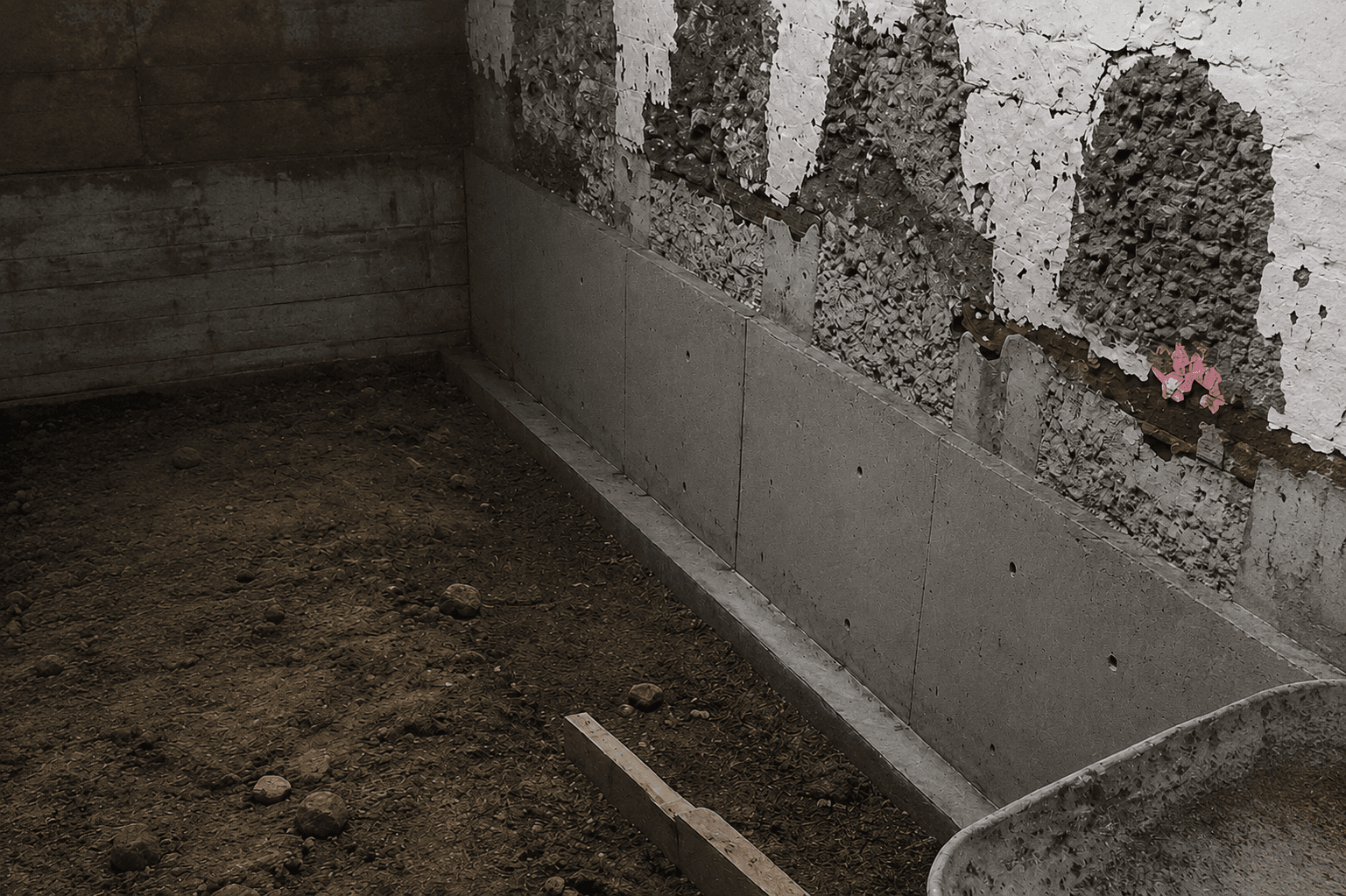
Underpinning proceeds in alternating 4-foot sections — never more than 25% of the foundation open at once.
Updated June 2026
What Does Basement Underpinning Cost in Toronto?
Prices below reflect 2026 Toronto market rates for homes in the City of Toronto proper. Final cost depends on perimeter length, target depth, soil conditions, and access constraints (narrow lots, mature trees, party walls).
Loses 12–18" of floor space per wall. Best when budget is the priority.
Full floor plan preserved. Required for legal basement apartments.
~130 lf perimeter, with engineering and permits (~$5K–$12K combined) included.
Typical Total Cost by Starting Ceiling Height
Based on a standard 25 × 40 ft Toronto semi-detached (~130 lf perimeter). Includes engineering, permit, drainage, and slab.
- Target height
- 7'6" – 8'0"
- Depth added
- 22 – 30"
- Common in
- Victorian/Edwardian, The Annex
- Target height
- 7'6"
- Depth added
- 14 – 20"
- Common in
- Interwar (1920s–40s), Danforth, Leslieville
- Target height
- 7'6"
- Depth added
- 10 – 14"
- Common in
- Post-war (1950s–60s), East York, Etobicoke
| Starting Height | Target Height | Depth Added | Typical Cost Range | Common In |
|---|---|---|---|---|
| 5'6" – 5'10" | 7'6" – 8'0" | 22 – 30" | $90,000 – $150,000 | Victorian/Edwardian, The Annex |
| 5'10" – 6'4" | 7'6" | 14 – 20" | $75,000 – $120,000 | Interwar (1920s–40s), Danforth, Leslieville |
| 6'4" – 6'8" | 7'6" | 10 – 14" | $75,000 – $100,000 | Post-war (1950s–60s), East York, Etobicoke |
Engineering + Permit Costs
Geotechnical soil report ($1,500–$3,500) + structural engineering drawings ($2,500–$6,000) + Toronto Building permit ($1,000–$2,500) = combined soft costs of $5,000–$12,000 — already counted in the all-in ranges above.
Access Premiums
Narrow side yards (under 4 ft) requiring hand excavation add $8,000–$15,000. Mature tree root management adds $2,000–$5,000. Rubble stone foundation reinforcement adds 15–25% to base costs.
City of Toronto Subsidy
Underpinning Is the Cheapest Moment to Flood-Proof Your Basement
During underpinning, the old slab is already broken out and new drainage is going in — so adding a backwater valve and sump system costs a fraction of retrofitting them later. The City of Toronto's Basement Flooding Protection Subsidy reimburses eligible homeowners up to $6,650 for this work (for work completed on or after November 12, 2025).
We plan the valve and sump locations into the underpinning drawings, so the flood-protection work happens while the slab is open instead of as a second dig.
What the subsidy covers
- Backwater valveUp to $1,600
Per device, maximum 2 devices
- Sump pumpUp to $2,250
Plus $300 for a battery backup
- Foundation drain pipe severance & cappingUp to $400
- Plumbing investigationUp to $500
Amounts apply to work completed on or after November 12, 2025. Verified June 2026 — see toronto.ca for current eligibility rules.
Want a number for your house? Book your walkthrough or call (437) 545-0067
Book your walkthroughWho Does the Work
RenoNext is the contractor on site — not a directory or referral service. Our founder is a BCIN-certified building designer and Quantity Surveyor, so the structural drawings, permit submissions, and cost estimates behind your project are reviewed in-house.
Follow every pour from your phone
Every underpinning project runs on our live client app. You see daily photos of each section pour, inspection reports shared in the app the day they happen, spend vs budget in real time, and milestone approvals before any payment is released.
Underpinning happens below your floorboards — the app means you never have to wonder what is going on down there.
The Underpinning Process in 6 Phases
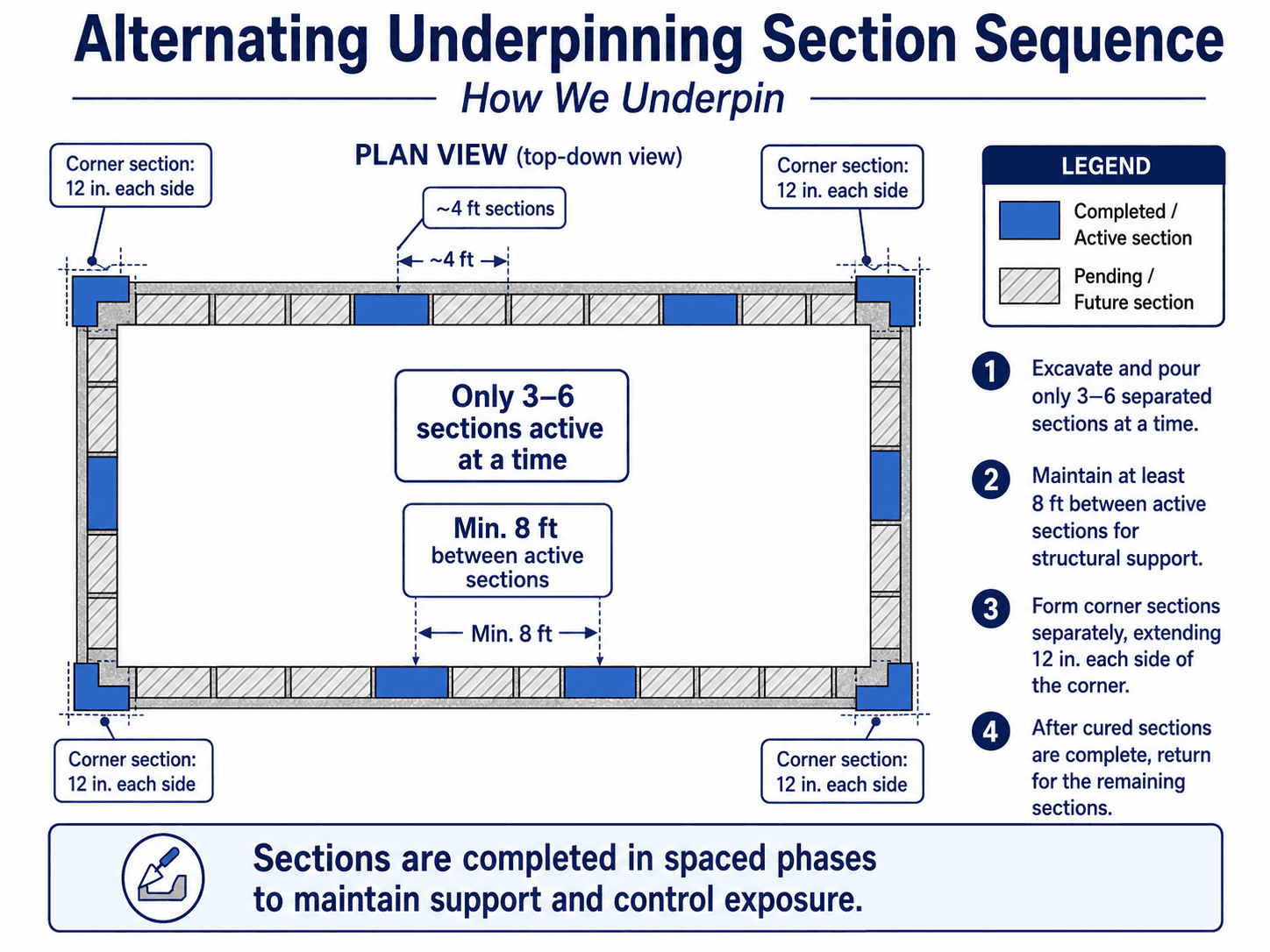
Basement lowering in Toronto is done in alternating 4-foot sections under a Toronto Building permit — your home stays structurally supported and you stay living in it throughout the 8–16 week process.
Here is what happens from permit application to final inspection.
Engineering & Permits
A structural engineer designs the underpinning layout and section sequence. A geotechnical engineer produces a soil report. Toronto Building reviews and issues a permit — typically 4–8 weeks.
Site Preparation & Shoring
The basement is cleared and the foundation wall is marked into alternating 4-foot sections. Temporary shoring is installed to support floor loads while sections are being excavated.
Alternating Excavation
Odd-numbered sections are excavated first — hand-digging beneath the existing footing to the new depth. No two adjacent sections are ever open simultaneously, keeping your home structurally supported at all times.
Forming & Concrete Pours
Each excavated section is formed, rebar is placed (inspected by Toronto Building), and 25–32 MPa concrete is poured. The section cures for 7+ days before the crew moves to even-numbered sections and repeats.
Drainage, Slab & Waterproofing
New weeping tile and a sump system are installed. A reinforced concrete floor slab is poured at the lower elevation with a vapor barrier. Exterior waterproofing membrane is applied if the wall was exposed.
Final Inspection & Backfill
Toronto Building performs the final inspection; your engineer issues a compliance letter. Exterior excavations are backfilled with granular material, graded to drain away from the foundation.
Why alternating sections?
No more than 25% of the foundation perimeter is ever open at once. Odd-numbered sections cure to full strength before even-numbered sections are excavated. This is the code-required approach in Ontario — not optional, not a style choice. It keeps your home safe and your neighbors' properties unaffected.
Questions about your house?
Free walkthroughs across Toronto & the GTA — no obligation.
(437) 545-0067Toronto Underpinning Permits: What You Need
Underpinning is classified as a structural alteration. Toronto Building will not allow construction to start without a valid building permit — and for good reason. Here is what is required.
Soil classification, bearing capacity, water table depth.
Stamped by Ontario P.Eng. Shows section sequence, rebar, and concrete specs.
Temporary support system for adjacent soil and structure.
Engineer pledges field reviews at each inspection stage.
Filed with Toronto Building; triggers plan examination.
Permit Timeline at a Glance
Engineering & Soil Report
Application Submitted to Toronto Building
Plan Examination
Revisions (if required)
Permit Issued — Construction Starts
Plan ahead: If you want to start construction in April or May, begin your permit application in January. Spring is the busiest season; late applications push your start date into summer.
Questions about permits for your house? Call (437) 545-0067 — we manage the drawings, application, and inspections for you.
Why Toronto Homeowners Underpin
With Toronto home prices averaging $1M+ for a semi-detached, underpinning is one of the highest-ROI renovations available. Here are the four most common goals.
Legal Basement Apartment
Toronto's Second Suite Bylaw allows basement apartments in most residential zones — but your ceiling must reach a minimum 6'5" (ideally 7'6"+ for marketable rents). Underpinning unlocks $1,800–$2,600/month in rental income. At $2,200/month average, a $100,000 underpinning project breaks even in roughly 4.5 years through rent alone.
Basement apartment underpinning guideSecond Suite / In-Law Suite
Multi-generational living is the fastest-growing reason for underpinning in Toronto. A self-contained in-law suite with a separate entrance, bedroom, bathroom, and kitchenette gives aging parents or adult children independence without leaving the property. Property value typically increases $100,000–$250,000 with a compliant second unit.
Second suite underpinning guide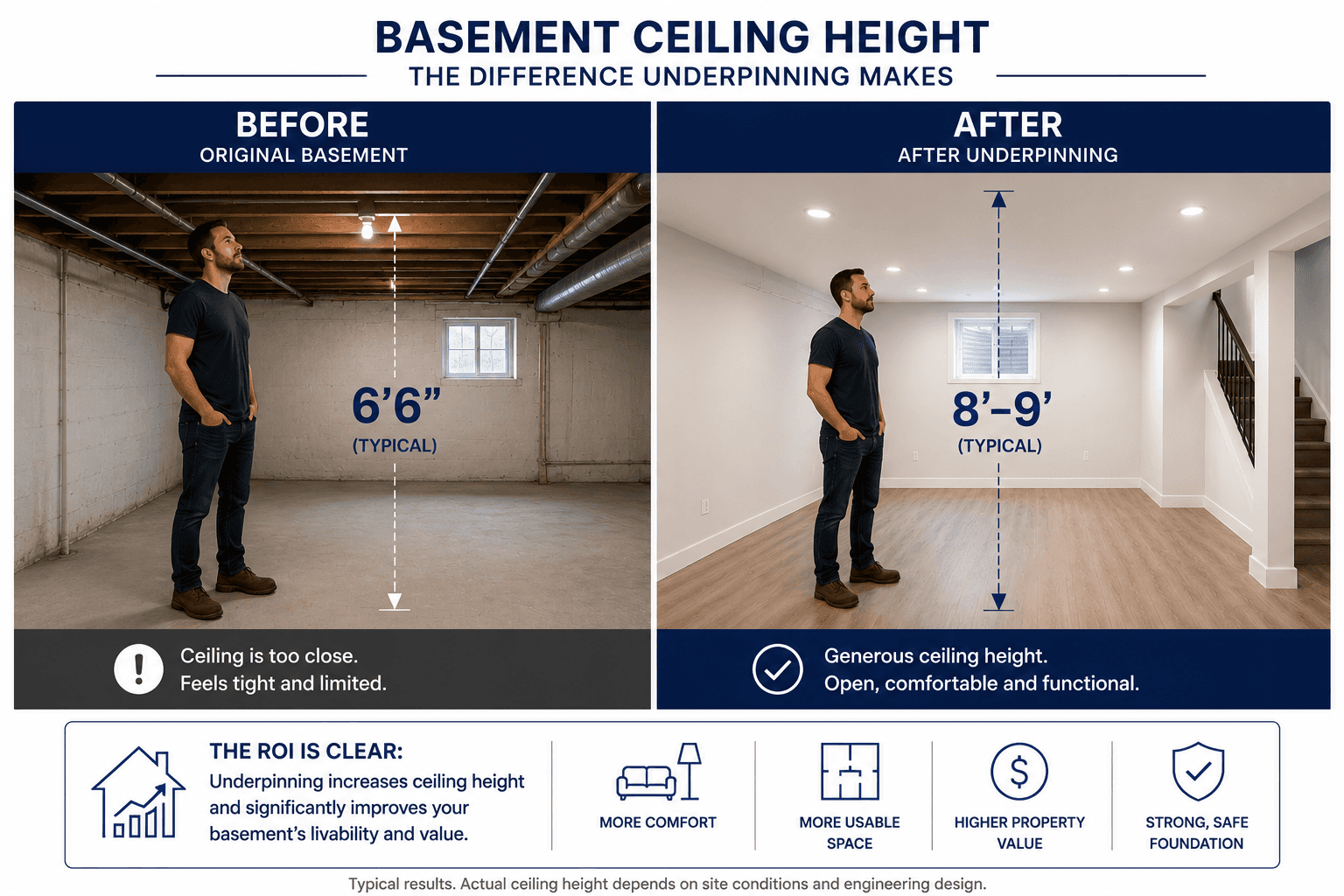
From Unusable Cellar to Full Living Space
Most pre-1960 Toronto homes — the 1920s semi-detached bungalows of East York, the Edwardian homes in Riverdale, the Victorian row houses of Leslieville — were built with basement ceiling heights of 5'6" to 6'4". These spaces were designed for coal storage and furnaces, not living.
Underpinning lowers the floor by 12–30 inches, bringing ceilings to 7'6"–9'0". The transformation is structural: new reinforced concrete footings at a lower bearing depth, a new floor slab, and a code-compliant space ready for finishing.
Underpinning vs Bench Footing: Which Is Right for You?
We use both methods — the right choice depends on your basement and budget. Here is the key tradeoff.
Mass-Concrete Underpinning
Excavates beneath the existing footing and pours new, deeper footings in alternating sections. No floor space is lost. The only method that fully preserves your floor plan — essential when you need every square foot for a rental apartment. Costs $500–$800/lf.
Bench Footing
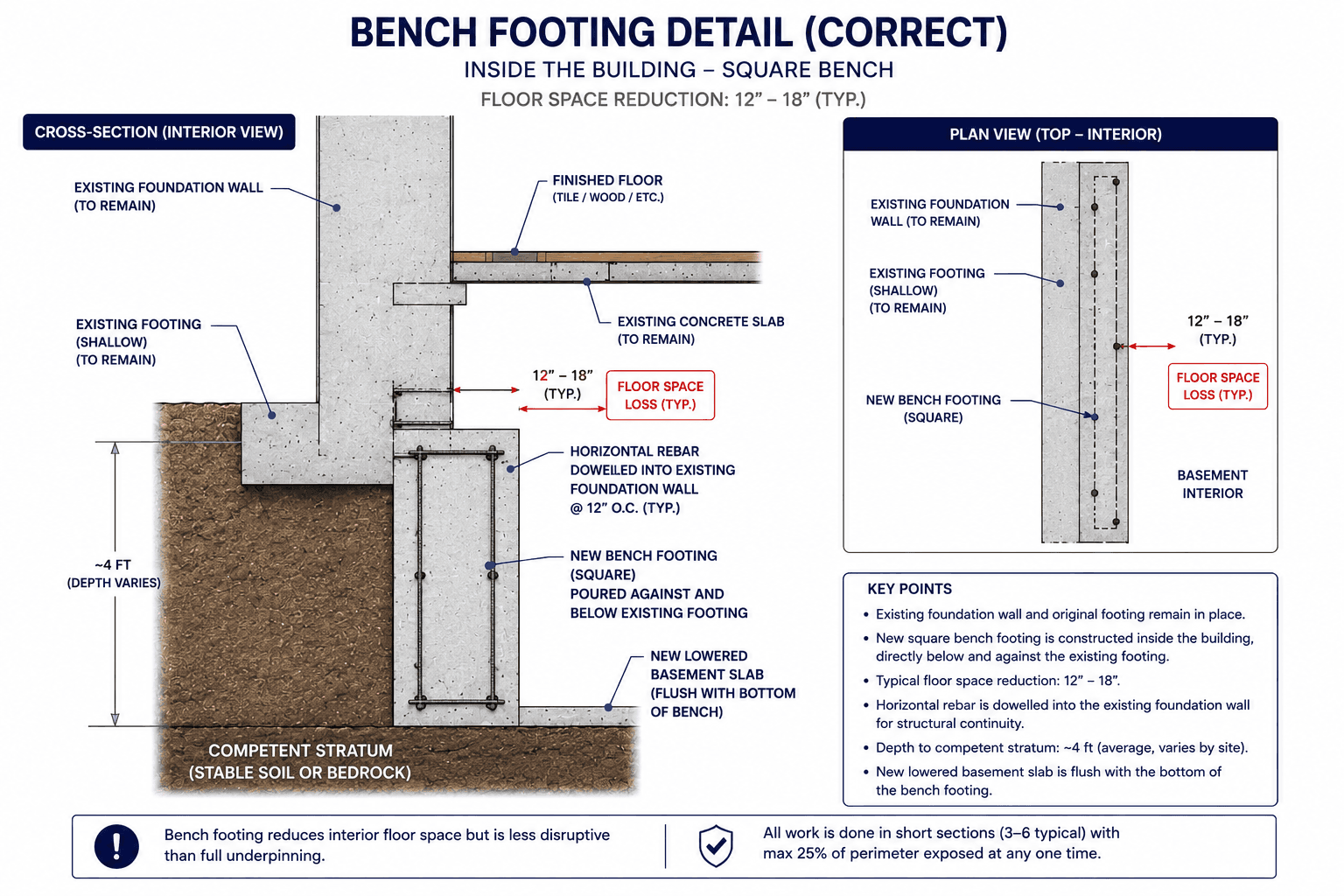
Pours a concrete ledge against the inside of the foundation wall down to the new depth. Costs 30–40% less ($300–$500/lf) but loses 12–18 inches of floor width per wall. On a typical 25×40 ft Toronto semi, full-perimeter bench footing shrinks the basement by ~75 sq ft — the equivalent of a small bedroom. Best for budget-conscious projects or where one or two walls need lowering.
Quick Decision Guide
Underpinning by Toronto Neighborhood
Each Toronto neighborhood has its own housing stock era, soil conditions, and access constraints. Select your neighborhood for a tailored guide to local pricing, challenges, and access considerations.
Underpinning in High Park-Swansea
Foundation underpinning specialists for High Park-Swansea heritage homes and century properties
Underpinning in Danforth-East York
Foundation underpinning for Danforth-East York bungalows and semi-detached homes with shared foundation expertise
Underpinning in The Annex
Foundation underpinning specialists for The Annex heritage Victorian and Edwardian homes
Underpinning in Leslieville
Foundation underpinning for Leslieville heritage cottages and semi-detached homes with high water table expertise
Underpinning in Riverdale
Foundation underpinning for Riverdale character homes with expertise in sloped lots and larger footprints
Ready to start? Book a free walkthrough — we'll measure your basement, confirm ceiling-height options, and give you a fixed milestone price.
Compare Toronto underpinning contractorsFrequently Asked Questions
Real questions from Toronto homeowners planning underpinning projects.
Ready to Start Your Toronto Underpinning Project?
Book a free walkthrough with RenoNext — WSIB covered, OBC licensed, and experienced with Toronto's clay soil, century homes, and semi-detached party walls.
Not ready? Check your price in 2 minutes
Licensed & Insured
WSIB covered, fully insured, and licensed under the Ontario Building Code.
Toronto Expertise
Deep familiarity with Toronto clay soil, rubble stone foundations, narrow lots, and party wall requirements.
Watch your underpinning happen — from upstairs
Our live client app shares daily photos of each section pour, inspection reports, spend vs budget, and milestone approvals — so you always know what is happening below your floorboards.