
Underpinning Cost in Toronto
Toronto underpinning prices are at the Ontario baseline. Expect to pay $500 – $800 per lin. ft.
$500
Starting from
6-12 weeks
Typical timeline
15%
Contingency
3
Rebate programs
Written by Pavel Vysotckii
BCIN-certified building designer & Quantity Surveyor · Updated June 2026
Underpinning Cost Breakdown — Toronto
| Scope (Toronto) | Low | High | Unit | Labour | Material |
|---|---|---|---|---|---|
| Excavation + underpinning piers (per linear foot) | $500 | $800 | per lin. ft | 65% | 35% |
| Full basement lowering, all-in (typical Toronto semi) | $75,000 | $150,000 | per project | 60% | 40% |
| Per-square-foot equivalent (basement floor area, same scope) | $80 | $160 | per sq ft | 60% | 40% |
| Geotechnical investigation + soil report (borehole) | $2,500 | $5,000 | per project | 85% | 15% |
| Structural engineering (design, stamped drawings, field reviews) | $3,500 | $8,000 | per project | 85% | 15% |
| Building permit fees | $1,500 | $4,000 | per project | 80% | 20% |
| Backwater valve (supply + install) | $2,000 | $4,000 | per valve | 60% | 40% |
| Sump pit + pump with battery backup | $1,500 | $3,500 | per system | 55% | 45% |
| Interior weeping tile (full perimeter) | $2,500 | $6,000 | per project | 55% | 45% |
| Foundation waterproofing on new walls | $3,000 | $8,000 | per project | 60% | 40% |
| New concrete floor slab (vapour barrier + reinforcement) | $6,000 | $12,000 | per project | 55% | 45% |
| Helical pile underpinning (per pile, 8-12 needed) | $1,200 | $2,000 | per pile | 55% | 45% |
| Optional: basement walkout entrance | $15,000 | $30,000 | per walkout | 60% | 40% |
| Optional: egress window + well (cut-in) | $2,500 | $6,000 | per window | 60% | 40% |
Estimate Your Underpinning Cost
Dial in your perimeter, depth, and method to see how the range moves.
Underpinning Cost Calculator
Set your perimeter, depth, and method for an instant illustrative range.
Depth gained
Method
Common add-ons
Estimated total
$77,800 – $108,200
$560–$740 per lin ft × 130 ft
Engineering & permits (~$5,000–$12,000 combined) are included in these totals.
Book your walkthroughIllustrative estimate — soil, access, and scope move the number; book a free walkthrough for a fixed milestone price.
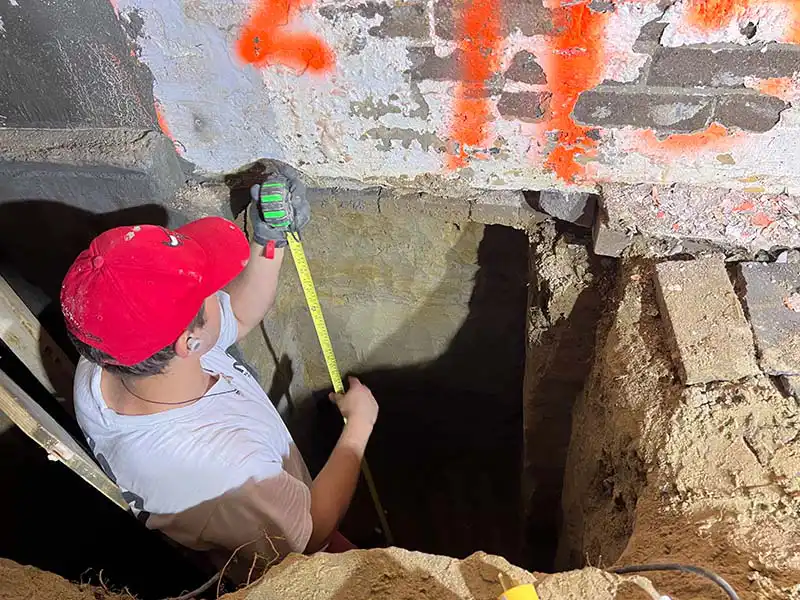
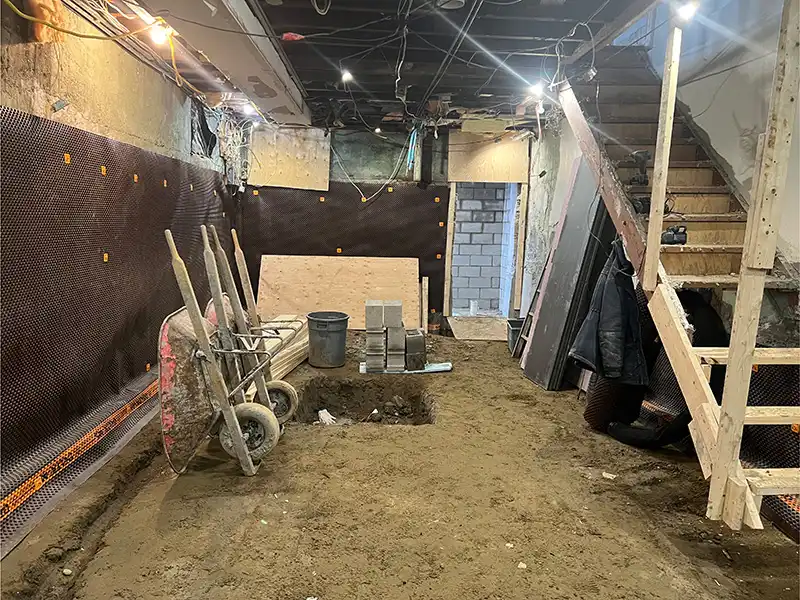
What Underpinning Work Looks Like
Real site photos from completed projects in the GTA.
Visual Price Ranges
Excavation + underpinning piers (per linear foot)
Full basement lowering, all-in (typical Toronto semi)
Per-square-foot equivalent (basement floor area, same scope)
Geotechnical investigation + soil report (borehole)
Structural engineering (design, stamped drawings, field reviews)
Building permit fees
Backwater valve (supply + install)
Sump pit + pump with battery backup
Interior weeping tile (full perimeter)
Foundation waterproofing on new walls
New concrete floor slab (vapour barrier + reinforcement)
Helical pile underpinning (per pile, 8-12 needed)
Optional: basement walkout entrance
Optional: egress window + well (cut-in)
Labour vs Materials in Toronto
Labour
100%
of Toronto baseline
Labour costs in Toronto match the Toronto baseline.
Materials
100%
of Toronto baseline
Material costs are relatively stable across the GTA. Toronto sees comparable material costs compared to Toronto.
Professional Fees
Underpinning in Toronto may require engineering or professional design services. These costs are in addition to the construction estimate.
Engineered Drawings
Professional Engineer (P.Eng) licensed in Ontario
Engineer specifies concrete strength, rebar schedule, excavation sequence, shoring requirements, and soil bearing assumptions. Site visits during construction are often included.
$3,500-$8,000
Permit Costs in Toronto
Toronto permit fees based on project value (typically $12-$15 per $1,000 of construction value).
Building Permit (Foundation Alteration)
City of Toronto or local municipality
$800-$2,500
Engineered Drawings
Professional Engineer (P.Eng) licensed in Ontario
$3,500-$8,000
Plumbing Permit (if relocating drains)
City plumbing inspector
$150-$400
Available Rebates in Toronto
Ontario Renovates
Ontario Ministry of Municipal Affairs
A forgivable loan for low-to-moderate income homeowners to make essential home repairs, accessibility modifications, or create a secondary suite. Delivered through local Service Managers.
Toronto Home Energy Loan Program (HELP)
City of Toronto
Low-interest financing for energy-efficient home improvements. Attached to your property tax bill — transfers if you sell. Covers insulation, windows, heat pumps, solar panels, EV chargers, and basement waterproofing.
Toronto Basement Flooding Protection Subsidy
City of Toronto
Subsidy for Toronto homeowners to install flood-protection devices: backwater valve (up to $1,600 per device, max 2 devices), sump pump (up to $2,250, plus $300 for a battery backup), foundation drain pipe severance and capping (up to $400), and plumbing investigation (up to $500). The $6,650 maximum applies to work completed on or after November 12, 2025. Figures confirmed as of June 2026.
Rebate amounts depend on eligibility and application. Some programs cannot be combined.
Phase-by-Phase Timeline
Engineering and permits
2-3 weeksStructural engineer designs the underpinning sequence, specifies concrete strength (25-32 MPa), rebar (#15M at 400 mm on center is typical), and footing width (depends on soil bearing capacity — Toronto clay at 75 kPa needs wider footings than bedrock at 500+ kPa). Drawings go to the city for a building permit. Engineer will specify geotechnical testing if soil conditions are unknown.
Shoring and interior prep
3-5 daysInstall temporary support beams inside the basement to carry floor loads while you remove foundation sections. If you're lowering the floor, this also involves demolishing the existing slab, relocating mechanical systems, and capping plumbing that's embedded in the concrete. HVAC ducts, electrical panels, and gas lines often need temporary relocation.
Excavation phase 1 (alternating sections)
2-3 weeksDig every other 4-ft section around the perimeter, going down to the new footing depth (usually 7-8 feet below grade for basement lowering). Hand-dig the last 12 inches to avoid disturbing the soil bearing surface. Each hole gets formed, rebar tied, and poured with 25-32 MPa concrete. You MUST let these cure for 7 days before digging the adjacent sections — concrete only reaches 75% of design strength at 7 days, but that's enough to carry the building load.
Excavation phase 2 (remaining sections)
2-3 weeksAfter phase 1 sections hit 7-day strength, excavate and pour the skipped sections. Now the entire perimeter has new footings at the target depth. The old foundation sits on top of the new concrete. If you're adding height, you'll pour a new wall section to connect the old foundation down to the new footing.
New floor slab and drainage
1-2 weeksExcavate the interior to the new floor elevation (typically 6-8 inches below the bottom of the new footing). Install weeping tile around the interior perimeter, sloped to a sump pit. Lay 4-6 inches of clear gravel, then poly vapor barrier, then pour a 4-inch reinforced slab. This is also when you pour the new concrete walls if you're adding basement height.
Backfill and exterior waterproofing
3-5 daysSince you've excavated the exterior, this is the ideal time to install a rubberized waterproofing membrane and new weeping tile on the outside. Backfill with gravel near the foundation (for drainage), then clay fill near grade (to slope water away). Many homeowners skip this step to save money and regret it 5 years later when water seeps through the foundation.
Inspections and finishes
1-2 days for inspectionsBuilding inspector reviews the footing excavations (before you pour), rebar installation, and final slab. Engineer does site visits at key stages. Once approved, you can finish the basement — framing, insulation, drywall, flooring.
What's Included vs Not Included
Typically Included
- Structural engineer design and stamped drawings
- Building permit application and fees
- Temporary shoring and bracing
- Excavation in alternating 4-ft sections
- Concrete footings (25-32 MPa) with #15M rebar
- New basement floor slab with vapor barrier
- Interior weeping tile and sump pump
- Basic exterior waterproofing
- Building inspections at key stages
Not Included (Extra Cost)
- Basement finishing (framing, drywall, flooring)
- HVAC relocation and ductwork modifications
- Electrical panel relocation
- Plumbing rough-in for new bathroom
- Exterior landscaping restoration
- Window well installation and enlargement
- Geotechnical soil report ($2,500-$5,000)
- Heated enclosures for winter work
Underpinning Costs in Nearby Cities
Peel Region
$474 – $758
per lin. ft
-5% vs TorontoYork Region
$485 – $776
per lin. ft
-3% vs TorontoYork Region
$482 – $771
per lin. ft
-3% vs TorontoDurham Region
$461 – $737
per lin. ft
-8% vs TorontoUnderpinning costs in all 15 cities: TorontoMississaugaBramptonVaughanMarkhamRichmond HillAuroraOakvilleBurlingtonMiltonAjaxPickeringOshawaWhitbyHamilton
Money-Saving Tips
Full lowering works out to roughly $80-$160 per square foot of basement area on a typical Toronto semi — beware quotes using a different scope, because per-square-foot numbers only compare if they cover the same work.
As a Quantity Surveyor, the first thing I check on a quote is the scope line. Published Toronto underpinning prices run anywhere from $50 to $450 per square foot because some figures are a dig-and-pour structural shell while others include a fully finished, rentable basement — the two are not comparable.
Depth and access drive the spread: every extra foot of lowering means more excavation, deeper piers, and more soil out the door — and a zero-lot-line semi where soil leaves by conveyor through the house costs more per foot than a detached home with side-yard machine access.
Soil conditions move the price too. Dense Toronto clay holds an excavation face better than sandy fill or a high water table, which can force shorter pier sequences, dewatering, and design changes — this is what the geotechnical report prices out before you commit.
If one bid is $30,000 lighter, read the exclusions before celebrating — slab, weeping tile, waterproofing, engineering, and HST are the lines most often missing from a low quote.
Get the geotechnical report — at $2,500-$5,000 it's cheap insurance for a $100K+ project.
Bundle waterproofing with underpinning to save 30-40% vs doing them separately.
Avoid winter work if possible — heated enclosures add $3,000-$8,000.
Plan all mechanical relocations before starting — mid-project changes during underpinning are extremely expensive.
Compare bench underpinning vs helical piles — piles are faster but limit future foundation modifications.
Underpinning Cost FAQs — Toronto
How much does underpinning cost in Toronto?
Underpinning in Toronto typically starts at $500 and ranges up to $800 per lin. ft. Toronto prices are at the Ontario baseline due to higher demand and labour costs in City of Toronto.
Do I need a permit for underpinning in Toronto?
Permit requirements for underpinning in Toronto follow City of Toronto guidelines. Toronto permit fees based on project value (typically $12-$15 per $1,000 of construction value).
How long does underpinning take in Toronto?
Underpinning in Toronto typically takes 6-12 weeks. Toronto project timelines can be affected by City of Toronto permit processing times (typically 2-8 weeks) and seasonal demand. Plan ahead for spring and summer, when contractor availability is tighter.
Is underpinning cheaper in Toronto than Toronto?
Toronto is the baseline for Ontario renovation pricing. Prices here reflect the highest labour costs in the GTA, but also the widest selection of experienced contractors and specialists.
What should I budget for underpinning contingency in Toronto?
We recommend a 15% contingency on top of your underpinning estimate in Toronto. This covers unexpected conditions like hidden water damage, structural issues, or material price changes. For a project estimated at $800, set aside an additional $120.
What happens if soil conditions differ from the borehole report?
A geotechnical report is based on one or two boreholes, so conditions can vary across the footprint. If the crew hits softer soil, groundwater, or obstructions, the structural engineer reviews the exposed conditions and adjusts the design — typically shorter pier sequences or revised footing details — and the change is priced as a documented change order against your contingency. This is exactly why underpinning carries a 15% contingency.
Who owns the relationship with the structural engineer?
Ideally you do. The engineer of record designs the underpinning sequence, stamps the drawings the building department requires, and performs field reviews at each stage. Insist on receiving the stamped drawings and field review reports directly — they become part of your home's permanent record and protect you if you ever sell or refinance.
How long does an underpinning estimate stay valid?
Most detailed underpinning estimates are valid for 30-60 days. Concrete, rebar, disposal, and crew pricing move with the season, so if your decision takes longer, ask for the estimate to be re-confirmed line by line rather than accepting a blanket percentage increase.
How do fixed milestone payments protect me on a project this size?
Payments tied to completed, inspected stages — permit issuance, each underpinning sequence, footing inspections, drainage and waterproofing, then the new slab — mean you only pay for work that exists and has passed inspection. Ontario's Construction Act also provides for a 10% holdback. Be cautious of any contract that front-loads large deposits before excavation begins.
What financing options exist for a $75,000-$150,000 underpinning project?
Most homeowners use a HELOC or mortgage refinance secured against the home. The City of Toronto's Home Energy Loan Program (HELP) finances eligible energy upgrades through the property tax bill — it does not pay for underpinning itself, but can help fund insulation and mechanical work done at the same time. Terms depend on your lender and situation; treat this as educational information, not financial advice.
Does any subsidy apply to underpinning work?
Underpinning itself is not subsidized, but if your home is in the City of Toronto, the Basement Flooding Protection Subsidy covers flood-protection devices typically installed during a lowering: up to $1,600 per backwater valve (maximum two devices), up to $2,250 for a sump pump plus $300 for battery backup, up to $400 for foundation drain pipe severance and capping, and up to $500 for plumbing investigation — to a maximum of $6,650 total for work completed on or after November 12, 2025.
Is bench footing a cheaper alternative to underpinning?
Yes — bench footing runs $300-$500 per linear foot versus $500-$800 for underpinning, because the existing footing stays in place and a concrete bench is poured against it. The trade-off is floor area: the bench steps into the room around the perimeter, which matters in an already-narrow semi. Underpinning costs more but keeps the full footprint usable.
Go Deeper Than the Numbers
Costs are only one part of an underpinning project. Our full Toronto guide walks through the construction process, permit requirements, and neighbourhood specifics.
Complete underpinning Toronto guide — process, permits, neighborhoodsShop Supplies for This Project
Browse tools, materials, and safety gear for your underpinning project in Toronto.
Get a Underpinning Quote in Toronto
Ready for a real number? Book a free walkthrough in Toronto — fixed milestone pricing, photos of every stage in the app.