
Underpinning
Dig under your existing foundation to add basement height or fix settlement. Do it right with alternating 4-ft pins and 7-day cures — dig adjacent sections too soon and you redistribute load paths into failure.
Written by Pavel Vysotckii
BCIN-certified building designer & Quantity Surveyor · Updated June 2026
Project Overview
Fixed Milestone Pricing
You approve each stage before it's paid
26-Step Visual Guide
See every phase with 34 real photos
What is underpinning?
Underpinning means digging under your house's existing foundation to pour new, deeper footings. You excavate in small sections (typically 4 feet wide), pour concrete to the new depth, let it cure, then move to the next section. The most common method in Ontario is bench underpinning: you dig alternating sections around the perimeter, cure for 7 days, then go back and do the skipped sections.
Why the alternating pattern? Because your foundation is a continuous load-bearing element. If you dig two adjacent 4-ft sections simultaneously, you're removing 8 linear feet of support. The load redistributes through the remaining foundation, and if the soil or existing footing can't handle that concentrated load, you get cracking or differential settlement — exactly what you're trying to fix.
OBC Part 9 Section 9.15 governs frost depth in Ontario: footings must extend below the frost line (typically 4 feet / 1.2 m in Southern Ontario, deeper in Northern regions). If you're lowering a basement floor, you're already excavating below that depth. If you're underpinning to stabilize settlement, the new footing must reach competent soil — in Toronto, that often means getting below fill and topsoil into the Halton Till clay layer, which has a bearing capacity of 75-100 kPa.
Helical piles are the alternative method: steel shafts with helical blades screwed into the ground until torque readings indicate you've hit the required bearing stratum. Brackets transfer the foundation load to the pile. Faster than bench underpinning (no concrete cure time), but you're locked into the pile locations — can't easily add windows or doors through the foundation later. Bench underpinning gives you a full-height concrete wall; helical piles give you point loads.
When you need underpinning
- Adding basement height by lowering the floor 2-4 feet (older Toronto homes often have 6'6" ceilings; underpinning gets you to 8'+ and makes the space livable)
- Foundation settlement causing cracks, sloped floors, or doors that won't close (if the footing wasn't deep enough or the soil is compressing, underpinning stabilizes it)
- Original footings are too shallow or too narrow (many pre-1950 homes have footings that don't meet modern OBC bearing area requirements)
- Adjacent excavation threatened your foundation (neighbor dug a basement or underground garage next door; your footing lost lateral support)
- Adding a new addition that requires matching foundation depth (you can't pour a shallow footing next to a deep one — frost heave will crack the junction)
- Transitioning from rubble stone foundation to poured concrete (heritage homes often have fieldstone foundations that are deteriorating; underpinning replaces them section by section)
- Soil erosion or water undermined the existing footing (if a buried stream or failed weeping tile washed soil out from under the foundation, you need to re-establish bearing)
Real Underpinning Work
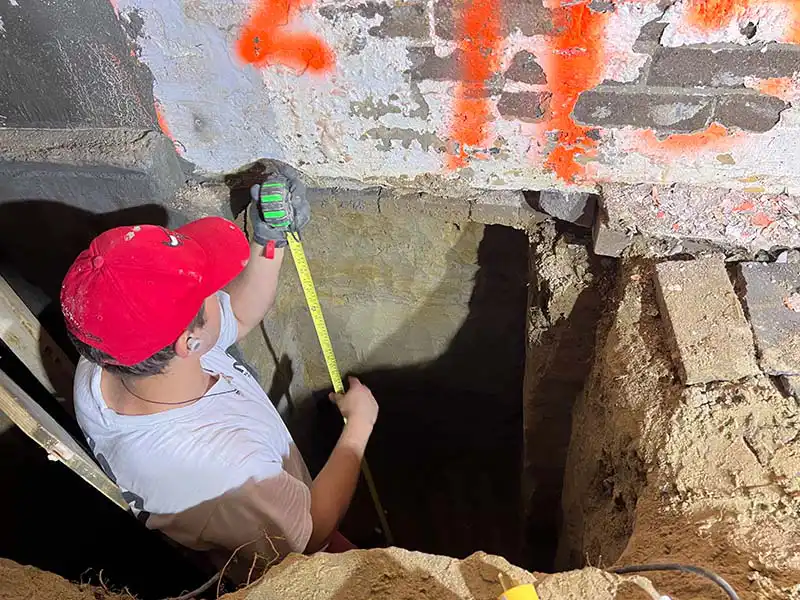
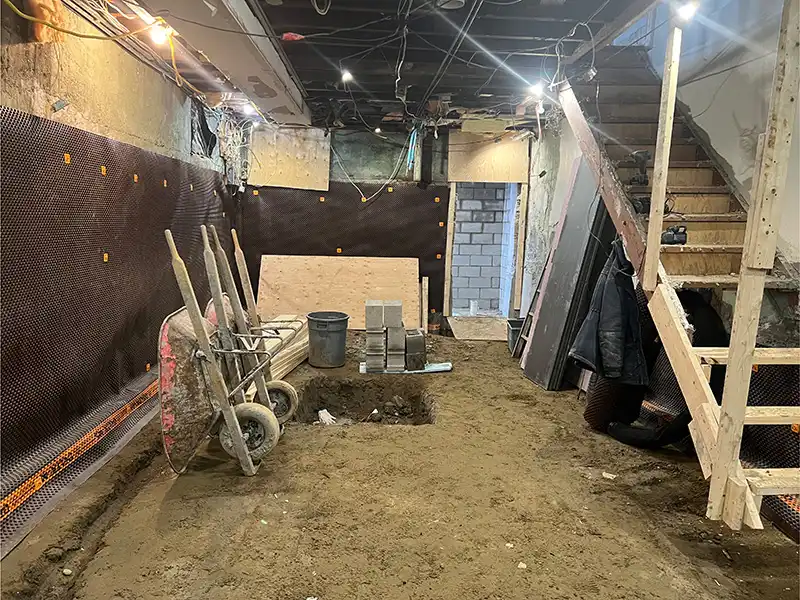
Photos from our own GTA projects — the same daily photo record you get in the client app.
The Process
What happens from start to finish
Engineering and permits
2-3 weeksStructural engineer designs the underpinning sequence, specifies concrete strength (25-32 MPa), rebar (#15M at 400 mm on center is typical), and footing width (depends on soil bearing capacity — Toronto clay at 75 kPa needs wider footings than bedrock at 500+ kPa). Drawings go to the city for a building permit. Engineer will specify geotechnical testing if soil conditions are unknown.
Shoring and interior prep
3-5 daysInstall temporary support beams inside the basement to carry floor loads while you remove foundation sections. If you're lowering the floor, this also involves demolishing the existing slab, relocating mechanical systems, and capping plumbing that's embedded in the concrete. HVAC ducts, electrical panels, and gas lines often need temporary relocation.
Excavation phase 1 (alternating sections)
2-3 weeksDig every other 4-ft section around the perimeter, going down to the new footing depth (usually 7-8 feet below grade for basement lowering). Hand-dig the last 12 inches to avoid disturbing the soil bearing surface. Each hole gets formed, rebar tied, and poured with 25-32 MPa concrete. You MUST let these cure for 7 days before digging the adjacent sections — concrete only reaches 75% of design strength at 7 days, but that's enough to carry the building load.
Excavation phase 2 (remaining sections)
2-3 weeksAfter phase 1 sections hit 7-day strength, excavate and pour the skipped sections. Now the entire perimeter has new footings at the target depth. The old foundation sits on top of the new concrete. If you're adding height, you'll pour a new wall section to connect the old foundation down to the new footing.
New floor slab and drainage
1-2 weeksExcavate the interior to the new floor elevation (typically 6-8 inches below the bottom of the new footing). Install weeping tile around the interior perimeter, sloped to a sump pit. Lay 4-6 inches of clear gravel, then poly vapor barrier, then pour a 4-inch reinforced slab. This is also when you pour the new concrete walls if you're adding basement height.
Backfill and exterior waterproofing
3-5 daysSince you've excavated the exterior, this is the ideal time to install a rubberized waterproofing membrane and new weeping tile on the outside. Backfill with gravel near the foundation (for drainage), then clay fill near grade (to slope water away). Many homeowners skip this step to save money and regret it 5 years later when water seeps through the foundation.
Inspections and finishes
1-2 days for inspectionsBuilding inspector reviews the footing excavations (before you pour), rebar installation, and final slab. Engineer does site visits at key stages. Once approved, you can finish the basement — framing, insulation, drywall, flooring.
Investment Guide
Underpinning is priced per linear foot of foundation or as a lump sum for full-perimeter jobs. Basement lowering (which includes underpinning + interior excavation + new slab) is significantly more expensive than underpinning alone for stabilization.
Underpinning only (stabilization, no floor lowering)
$500-$800 per linear foot
Depends on: Depends on depth, soil conditions, and accessibility. Jobs with tight side yards or no machinery access (hand-digging only) cost 30-50% more.
Full basement lowering (underpinning + excavation + slab)
$75,000-$150,000 for typical Toronto semi (25-30 ft perimeter per side)
Depends on: Includes shoring, underpinning, interior excavation, new slab, weeping tile, sump pump, and basic waterproofing. Does NOT include finishing, HVAC relocation, or structural beam upgrades.
Helical pile underpinning (alternative method)
$1,200-$2,000 per pile (typically need 8-12 piles for a full basement)
Depends on: Faster than bench method (no concrete cure time), but you lose the ability to add windows or doors through the foundation later. Best for tight timelines or poor soil where excavation is risky.
Engineering and permits
$5,000-$12,000
Depends on: Includes structural drawings, geotechnical report (if needed), permit fees, and 2-3 site visits during construction. More complex jobs (heritage homes, tight sites, poor soil) push toward the high end.
What Affects the Price
Get a detailed underpinning estimate with soil assessment, sequencing plan, and timeline. RenoNext vets contractors who do this work daily — no learning curves on your foundation.
Get a ballpark estimate in under 2 minutes.
Permits & Building Code
Ontario Building Code requirements
| Permit / Approval | Authority | Typical Cost |
|---|---|---|
| Building Permit (Foundation Alteration) | City of Toronto or local municipality | $800-$2,500 |
| Engineered Drawings | Professional Engineer (P.Eng) licensed in Ontario | $3,500-$8,000 |
| Plumbing Permit (if relocating drains) | City plumbing inspector | $150-$400 |
Inspections are required at multiple stages: after excavation (before pour), after rebar placement, and after final slab. Missing an inspection means tearing out concrete to expose the work.
If your property is designated heritage, you need additional approvals before altering the foundation. This can add 4-8 weeks to the permit timeline.
Shoring plans may require separate engineer review if you're excavating deeper than 4 feet or working in poor soil (sand, fill, soft clay).
Fixed Milestone Pricing, Approved by You
Every underpinning project runs on fixed milestone pricing. The plan is signed before work starts, and you approve each stage before it's paid.
Plan Signed Before Work Starts
Every milestone and its price is written into the contract up front — no surprise extras.
Review in the Live App
Daily photos, inspection reports, and spend vs budget land in your client app at every phase.
You Approve Each Milestone
A stage is only paid after you review the work and sign off in the app.
Project Center
Underpinning
Milestone Progress
Milestone 3 of 4
Underpinning failures and how they happen
- Digging adjacent sections simultaneously: If you excavate two 4-ft sections next to each other (8 linear feet of unsupported foundation), the load redistributes into the remaining foundation and soil. In weak soil, this causes immediate settlement. In clay, it creates micro-cracks that propagate over weeks. The 7-day cure between alternating sections exists for a reason — skipping it is gambling with your house's structural integrity.
- Pouring concrete in freezing temperatures without protection: Concrete needs to cure at 10°C or higher for the first 3 days to develop strength. If it freezes during that window, ice crystals disrupt the cement hydration reaction and you end up with 50-60% of design strength. Underpinning in winter requires heated enclosures, insulated blankets, and accelerator additives — budget an extra $3,000-$8,000.
- Skipping the geotechnical report in unknown soil: If you assume you're on clay but you're actually on fill or sand, your footing width will be undersized. Fill compresses under load; sand can liquefy if water saturates it. Both cause settlement. A geotech report costs $2,500-$5,000 and tells you the actual bearing capacity — designing footings without it is guessing.
- Not waterproofing while the foundation is exposed: You've already paid for excavation and shoring. Adding exterior waterproofing now costs $80-$150/ft. Doing it later means re-excavating the entire perimeter — that's $300-$500/ft because you're paying for excavation twice. Every underpinning project should include waterproofing; skipping it is leaving money in the ground.
- Undersized or missing shoring: Interior shoring beams carry the floor loads while you remove foundation sections. If you undersize the beams or space the posts too far apart, the main floor sags. Fixing this requires jacking the floor back up and adding permanent steel beams — $15,000-$30,000. Shoring is temporary, but it has to be engineered for the actual loads.
- Disturbing the soil bearing surface: When you dig the last 12 inches of the excavation, you MUST hand-dig to avoid over-excavating or churning the clay into mud. Machine excavators can't stop precisely at the target depth; they gouge 6-12 inches too deep. Backfilling that void with concrete doesn't restore the bearing capacity — you're pouring onto loose fill, not competent soil.
- Ignoring lateral earth pressure on new walls: If you're adding basement height, the new concrete wall sees lateral pressure from the soil outside. An 8-ft wall in clay with poor drainage can see 4,000+ lb/ft of lateral load. If the wall isn't thick enough (minimum 8 inches) or the rebar is undersized, it bows inward over 5-10 years. Horizontal cracks appear at mid-height. Fixing it requires interior bracing or exterior excavation and anchors — both expensive.
Trusted by Ontario Homeowners
One licensed crew and a live client app on every underpinning project
Licensed
OBC Licensed, Insured & WSIB Covered
Live App
Daily Photos & Inspection Reports
Fixed Price
Milestones You Approve
Related Services
We track concrete strength in real time on every pour
An embedded maturity sensor logs concrete core temperature and estimates in-place strength (ASTM C1074), so forms come off and loads go on based on data — not a calendar.
Common Questions
Can I underpin just one wall instead of the whole perimeter?
How much basement height can I actually gain?
What's the difference between underpinning and benching?
Can I live in the house during underpinning?
Do I need a geotechnical report if I'm in Toronto (clay soil)?
Why does underpinning cost so much more than a new foundation?
Can I use the basement during the 7-day cure between phases?
What happens if I hit water during excavation?
Is helical pile underpinning as strong as bench underpinning?
Do I need to upgrade my floor joists if I'm lowering the basement?
Where we do this work
Based in Toronto, working across the GTA
Ready to start your underpinning project?
One crew, one fixed plan, and the live app on every underpinning project. Daily photos, inspection reports, milestone pricing you approve — and a written warranty.