
Whitby underpinning specialists
Build Down
With Confidence.
Engineered basement lowering and foundation underpinning, built section by section and poured flush with the existing wall — with professional execution, dust control, and clear project visibility.
What Is Underpinning?
Underpinning strengthens and deepens an existing foundation — either to stabilize a settling structure or to increase basement ceiling height for livable space.
Mass-Concrete Underpinning
Excavates beneath the existing footing in alternating sections and pours new, deeper footings — preserving every inch of your floor plan.
- No floor space lost — walls stay flush
- Done in alternating 4-foot sections for safety
- Concrete strength: 25–32 MPa
Bench Footing
Pours a concrete bench against the inside of the foundation wall down to a new depth. A more affordable option with a tradeoff.
- 30–40% less than mass-concrete
- Sacrifices 12–18 inches per benched wall
- Best for wider basements where space loss is acceptable
25%
Max foundation exposed at any time
4 ft
Alternating section width
25–32
MPa concrete strength
8–9 ft
Target ceiling height
Licensed Structural Engineer Required
Every underpinning project requires a licensed structural engineer to design the layout — specifying the section sequence, concrete strength, and rebar requirements. Work is done in alternating sections so the home remains supported at all times.
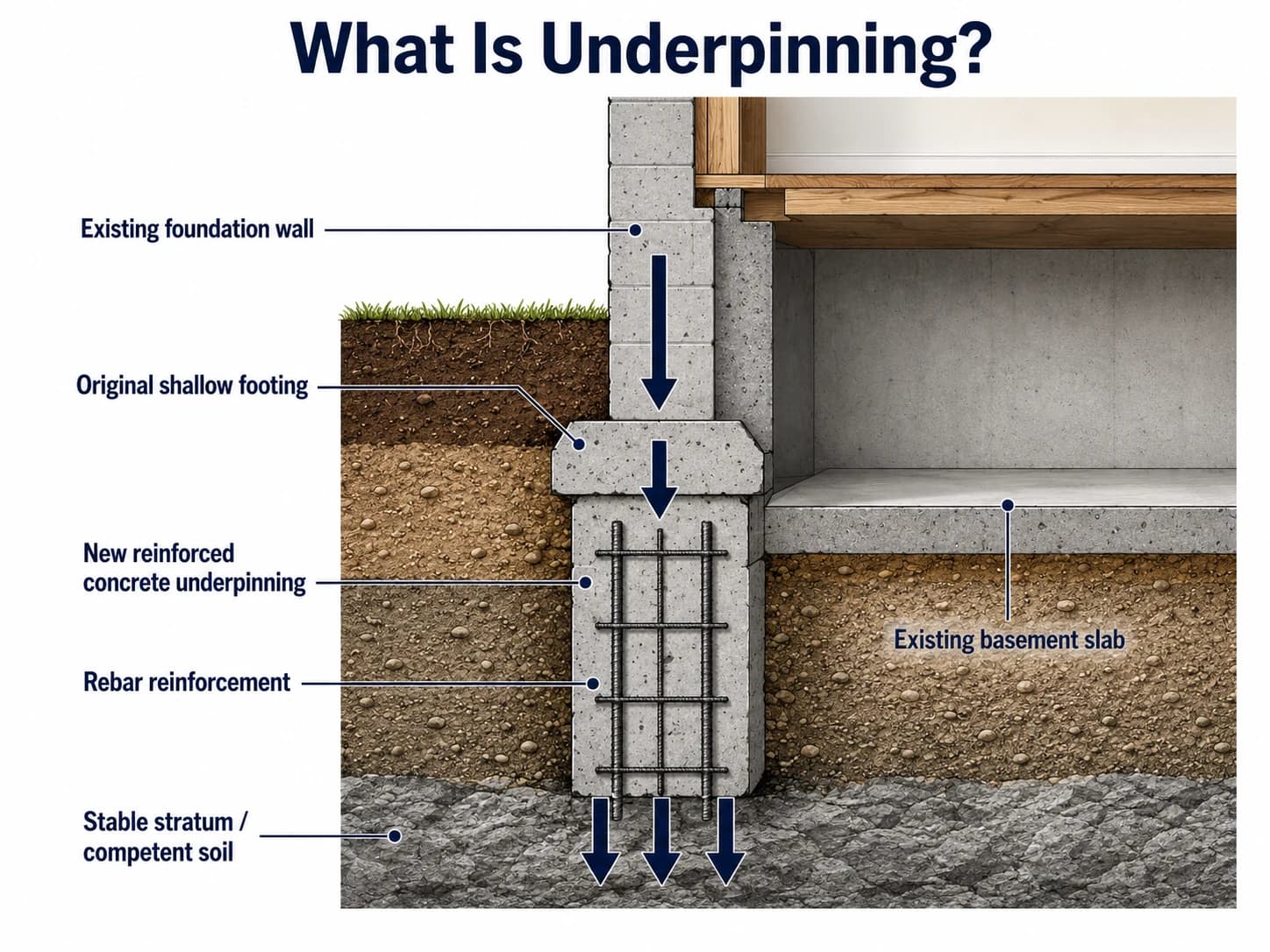
Existing Foundation Wall
Original structure requiring deeper support
New Reinforced Concrete
Structural extension beneath existing footing
Load Transfer to Stable Soil
Reaches competent bearing stratum below
Underpinning extends the foundation depth to transfer structural loads to stable soil layers, preventing settlement and structural damage
Signs Your Home May Need Underpinning
If you notice any of these signs in your Whitby home, it may be time for a professional underpinning assessment.
Low Basement Ceiling Height
Ceiling height under 6'6" makes your basement unusable for living space and non-compliant with Ontario Building Code for habitable rooms. Underpinning raises the ceiling to 8' or 9'.
Foundation Cracks
Horizontal cracks indicate lateral pressure from soil. Vertical cracks may show settling. Stair-step cracks in block foundations suggest differential settlement. All may require underpinning to stabilize.
Uneven or Sloping Floors
Floors that slope or feel uneven indicate foundation settlement. If one part of the foundation has sunk more than another, underpinning can level and stabilize the structure.
Doors and Windows That Stick
Doors and windows that suddenly become hard to open or won't close properly can indicate the foundation is shifting, causing the frame of the house to rack.
Persistent Basement Water Issues
If waterproofing alone hasn't solved your basement moisture problems, the foundation may have settled and cracked, creating pathways for water entry that only underpinning can address.
Visible Foundation Deterioration
Crumbling concrete, spalling, or exposed rebar indicates the foundation has deteriorated beyond repair and needs to be reinforced through underpinning.
Why Underpin Your Home?
Underpinning is one of the highest-ROI home improvements for Whitby homeowners — adding both space and value.
Create a Legal Basement Apartment
Ontario's second suite provisions allow basement apartments in most residential zones. Underpinning provides the ceiling height required by building code (minimum 6'5", typically 8'-9' for comfort).
Build an In-Law Suite
Multi-generational families can create self-contained in-law suites with a bedroom, bathroom, kitchen, and separate entrance through underpinning and basement finishing.
Generate Rental Income
A legal basement apartment generates $1,200 – $2,500/month in the GTA. At typical underpinning costs, the payback period is 4-7 years — plus the added property value.
Create Recreation Space
A full-height basement becomes a home gym, theatre room, playroom, or entertainment space — adding usable square footage without building an addition.
Stabilize a Settling Foundation
If your foundation has settled or cracked, underpinning restores structural integrity by transferring the building load to deeper, more stable soil.
Maximize Property Value
Underpinning adds $100,000 – $250,000 in property value in the GTA. A finished, full-height basement is one of the highest-ROI home improvements available.
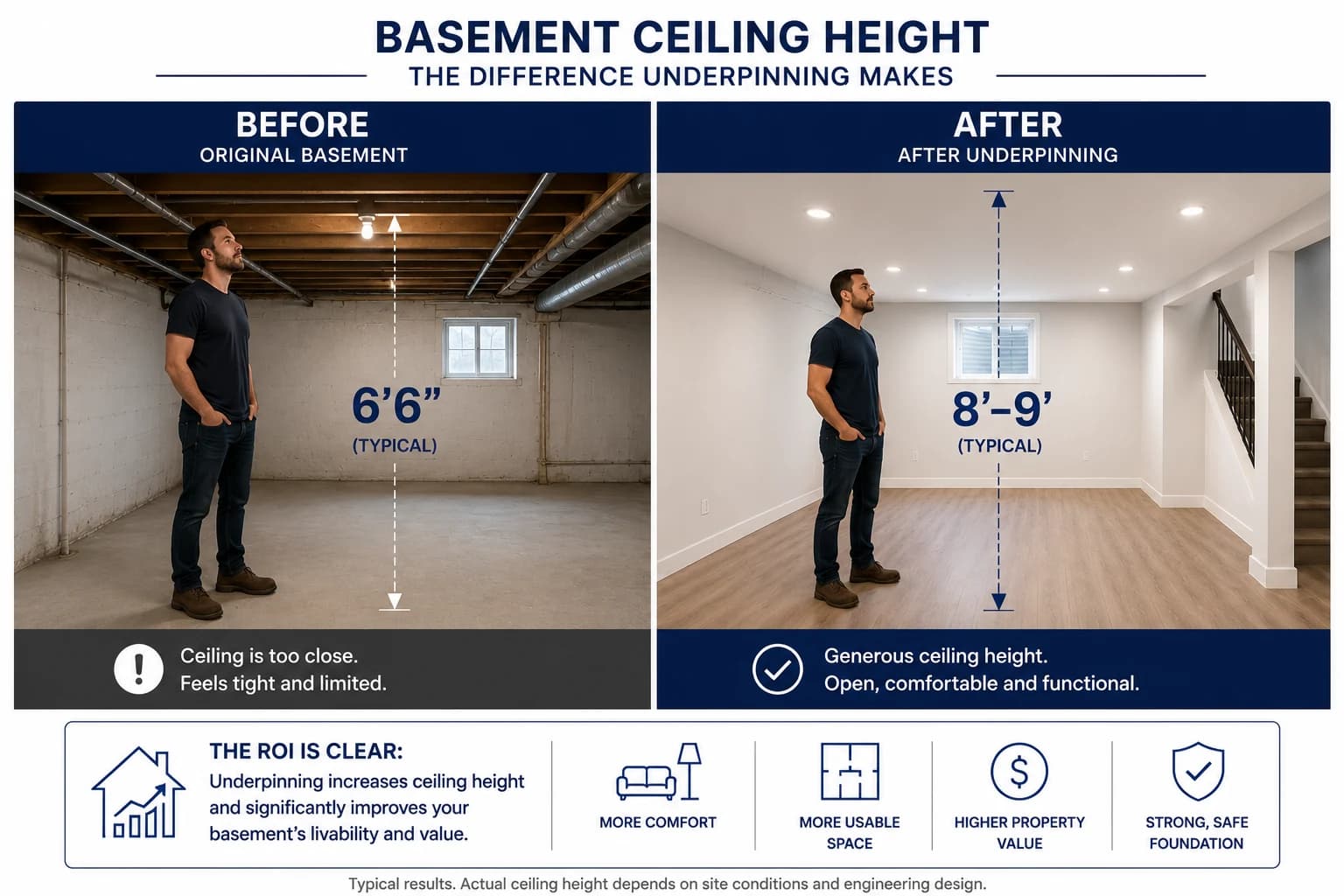
typical
Cramped, unusable space
typical
Full-height, livable basement
Return on Investment
Underpinning adds $100K–$250K in property value and $1,500–$2,500/mo rental income potential.
More Comfort
More Space
Higher Value
Stronger Foundation
What Underpinning Can Create
A lowered basement opens up possibilities — from legal rental suites to home gyms. Here's what Whitby homeowners are building.
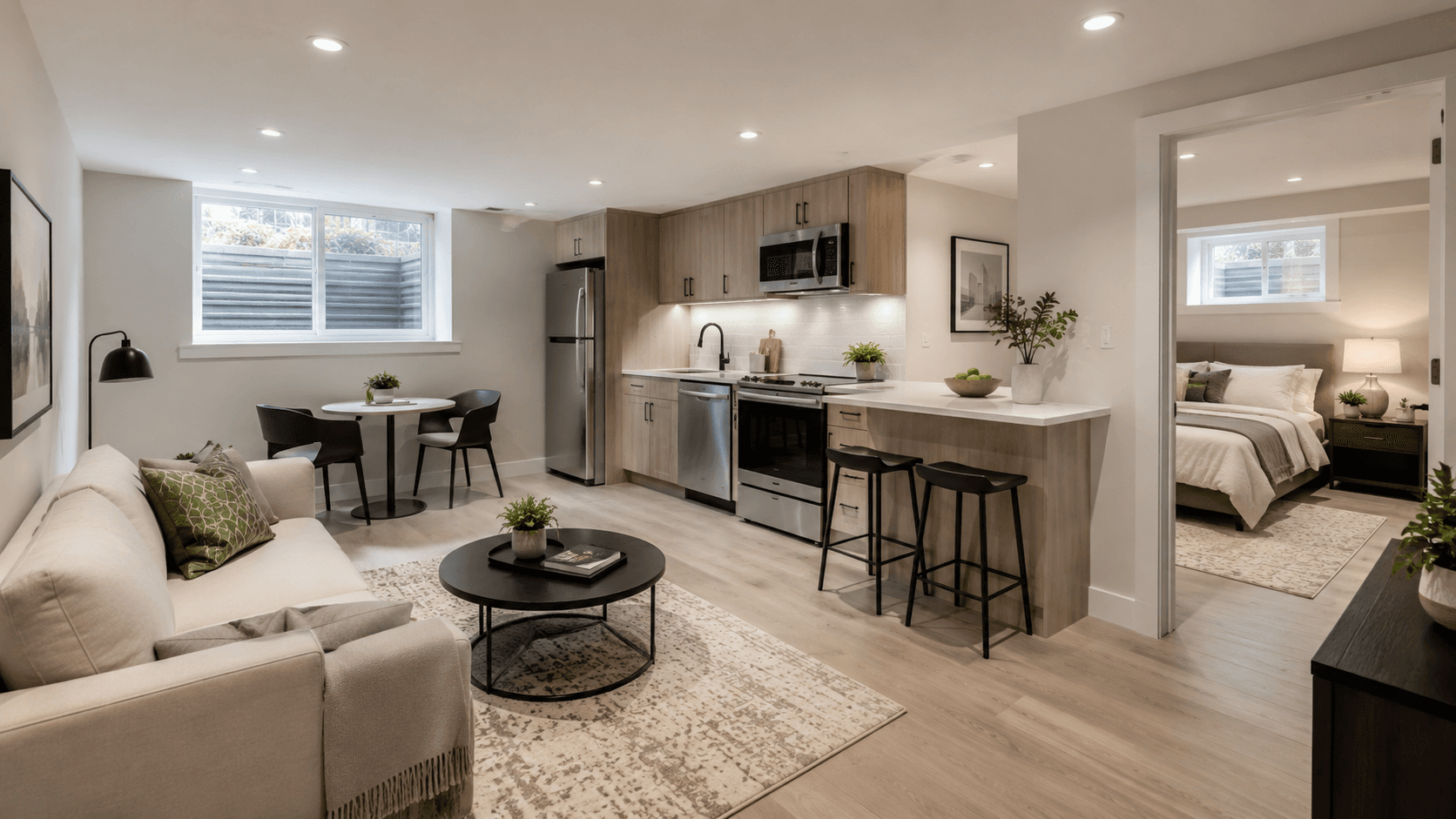
Legal Basement Suite
Full apartment with kitchen, bathroom, bedroom, and living area. Generates $1,500–$2,500/mo in rental income.
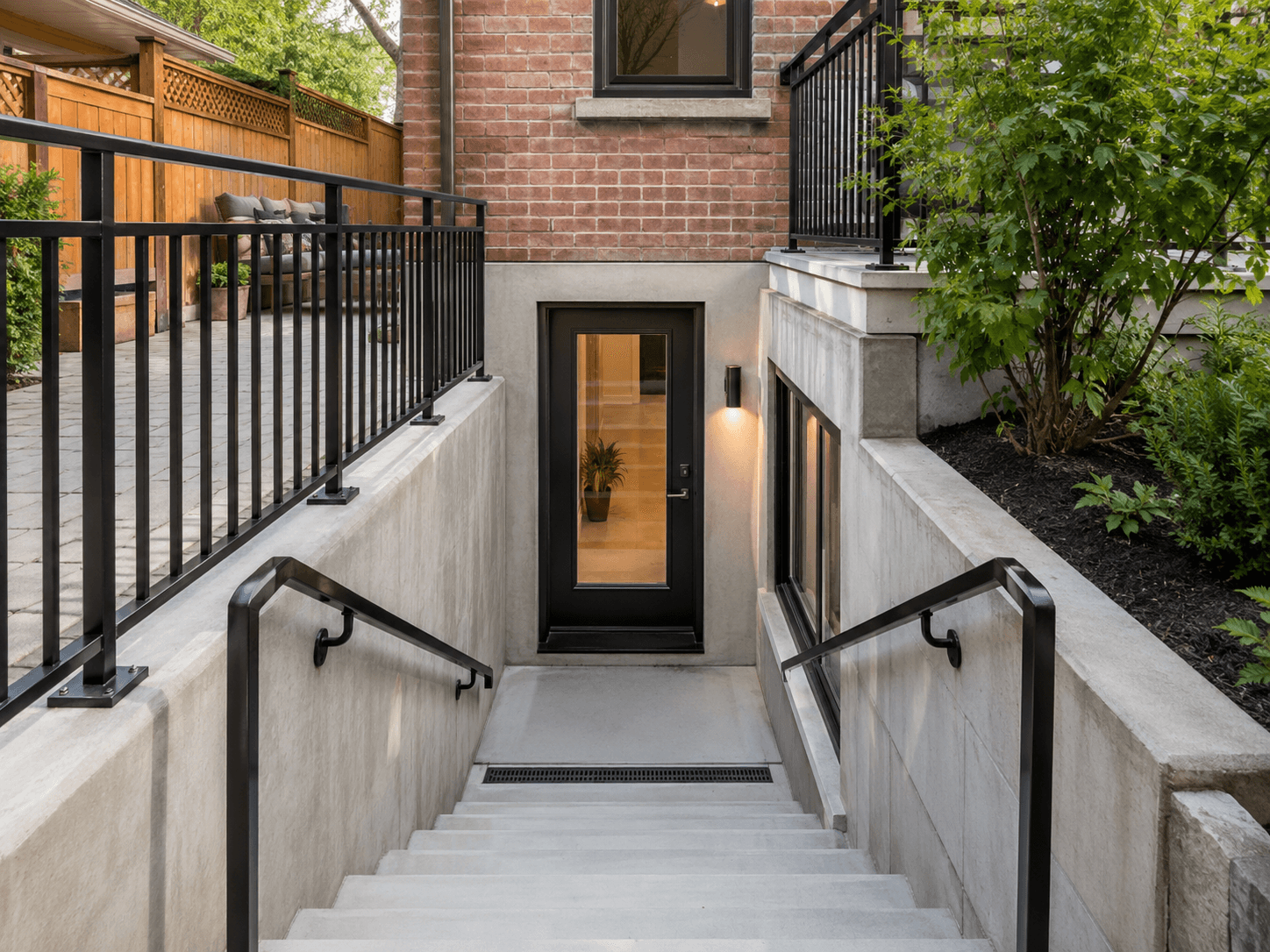
Separate Entrance
Dedicated exterior entrance with concrete stairs, railings, and egress-compliant door. Required for legal second suites.
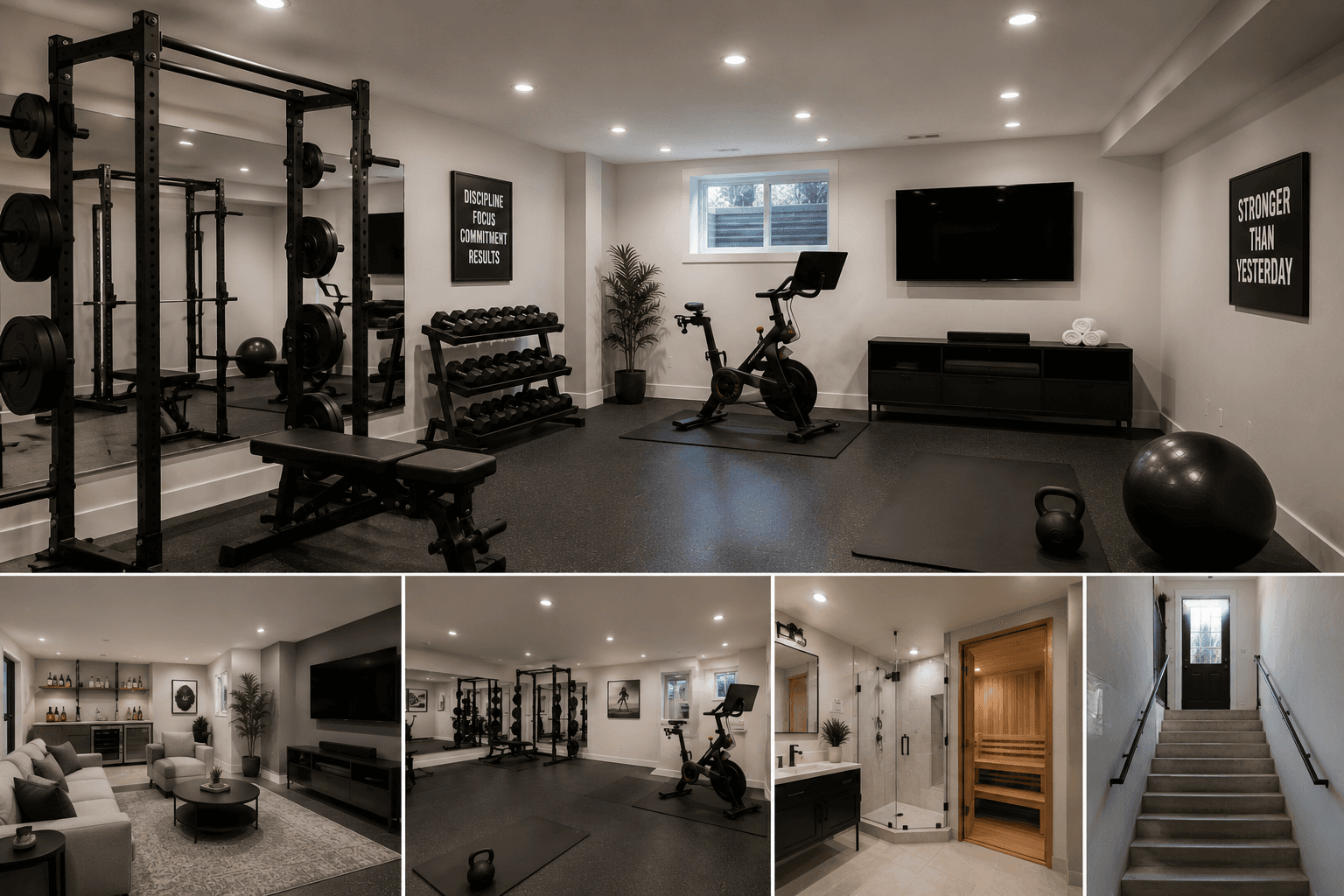
Home Gym & Rec Room
Full-height ceiling allows power racks, heavy bags, and proper ventilation. Add a sauna, theatre, or game room.
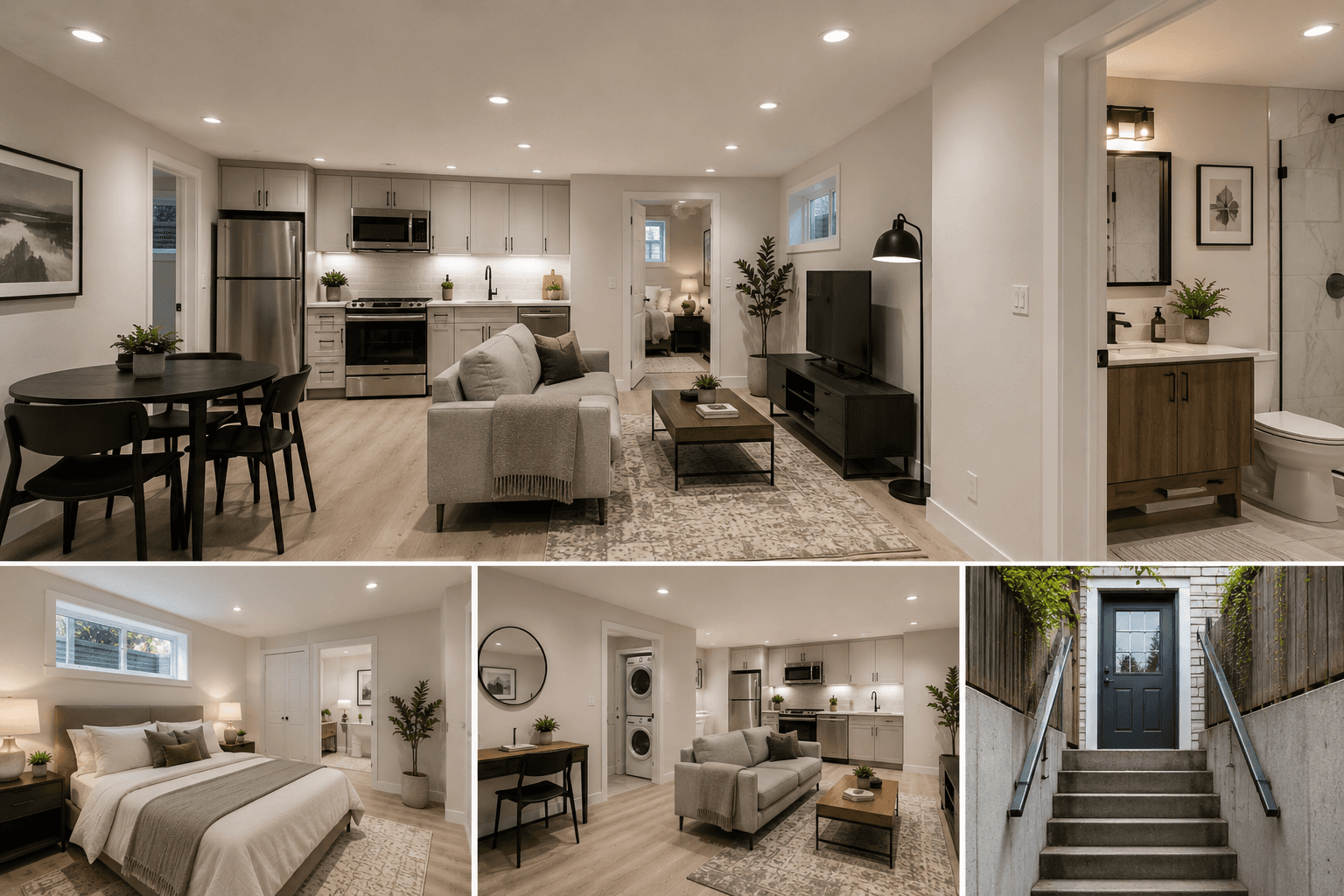
Full Apartment Conversion
Living room, kitchen, bedroom, bathroom, and separate entrance — a complete second dwelling unit built from a formerly unusable basement. Property value increase: $100K–$250K.
In-Law Suite
Guest Suite & In-Law Suite
Self-contained living space for aging parents or extended family. Private bedroom, bathroom, kitchenette, and shared or separate entrance.
Understanding the Angle of Repose
The angle of repose is the steepest angle at which soil can maintain stability without sliding. In underpinning, this concept is critical because excavating below an existing footing removes the soil that supports it. If the excavation extends beyond the angle of repose, the adjacent soil — and the footing above it — can collapse.
In Toronto's clay soil, the angle of repose is typically 45 degrees (1:1 ratio). This means for every foot you dig down, you must stay at least one foot back from the edge of the existing footing. Structural engineers calculate the safe excavation profile for each project based on the specific soil conditions identified in the geotechnical report.
This is why underpinning must be done in alternating sections — each section is small enough that the adjacent, un-excavated sections support the building load while the new footing is poured and cured.
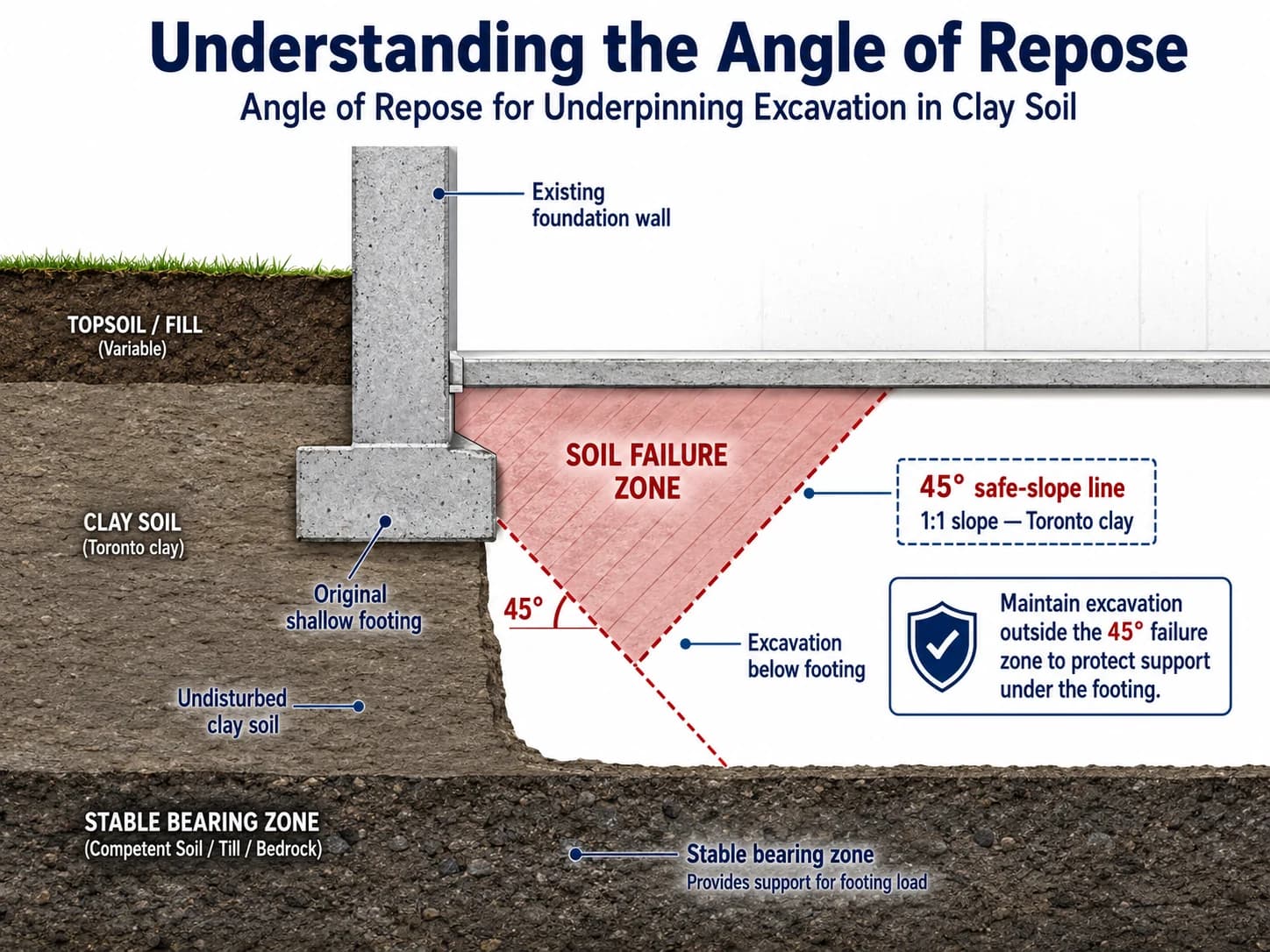
45° Safe-Slope Line
Excavation must remain outside the failure zone projected at 45 degrees from the underside of the existing footing to protect lateral support
Toronto Clay Soil
Local glacial clay exhibits cohesive properties that allow vertical excavation faces within safe limits when proper sequencing and exposure control are maintained
Maintain excavation outside the 45° failure zone to protect support under the footing
Why This Matters for Your Whitby Home
Proper understanding of the angle of repose is what separates qualified underpinning work from risky shortcuts. Ignoring soil mechanics risks catastrophic foundation failure. Our team works exclusively with licensed structural engineers who calculate the safe excavation profile for every project.
Underpinning Methods Compared
Understanding the difference helps you choose the right approach for your Whitby home. Read the full comparison →
| Factor | Mass-Concrete Underpinning | Bench Footing |
|---|---|---|
| How it works | Excavate beneath existing footing in alternating sections, pour new deeper footings | Pour a concrete bench against the inside of the foundation wall to a lower depth |
| Floor space impact | None — full floor plan preserved | Loses 12–18" per wall |
| Best for | Full basement lowering, maximum livable space | Budget-conscious lowering, 1–2 walls, non-living areas |
| Cost | $500 – $800 per linear foot | $300 – $500 per linear foot |
| Timeline | 8–16 weeks for full basement | 6–10 weeks for full basement |
| Disruption | Significant — full basement excavation required | Moderate — less excavation than mass-concrete |
| Adds ceiling height? | Yes — primary purpose | Yes — but at the cost of floor area |
| Structural complexity | High — requires precise alternating sequence | Medium — simpler forming and pouring |
| Engineering required? | Yes — structural + geotechnical | Yes — structural + geotechnical |
Will I Lose Floor Space?
The answer depends entirely on the method used. Mass-concrete underpinning excavates beneath the existing footing and preserves every inch of your floor plan. Bench footing builds a new concrete ledge against the inside of the wall — gaining ceiling height but narrowing the room.
On a typical 25×40-foot Toronto semi-detached, bench footing on all four walls loses roughly 75 square feet — equivalent to a small bedroom. On a 15-foot-wide rowhouse, the loss is more noticeable because it's a larger percentage of an already narrow space.
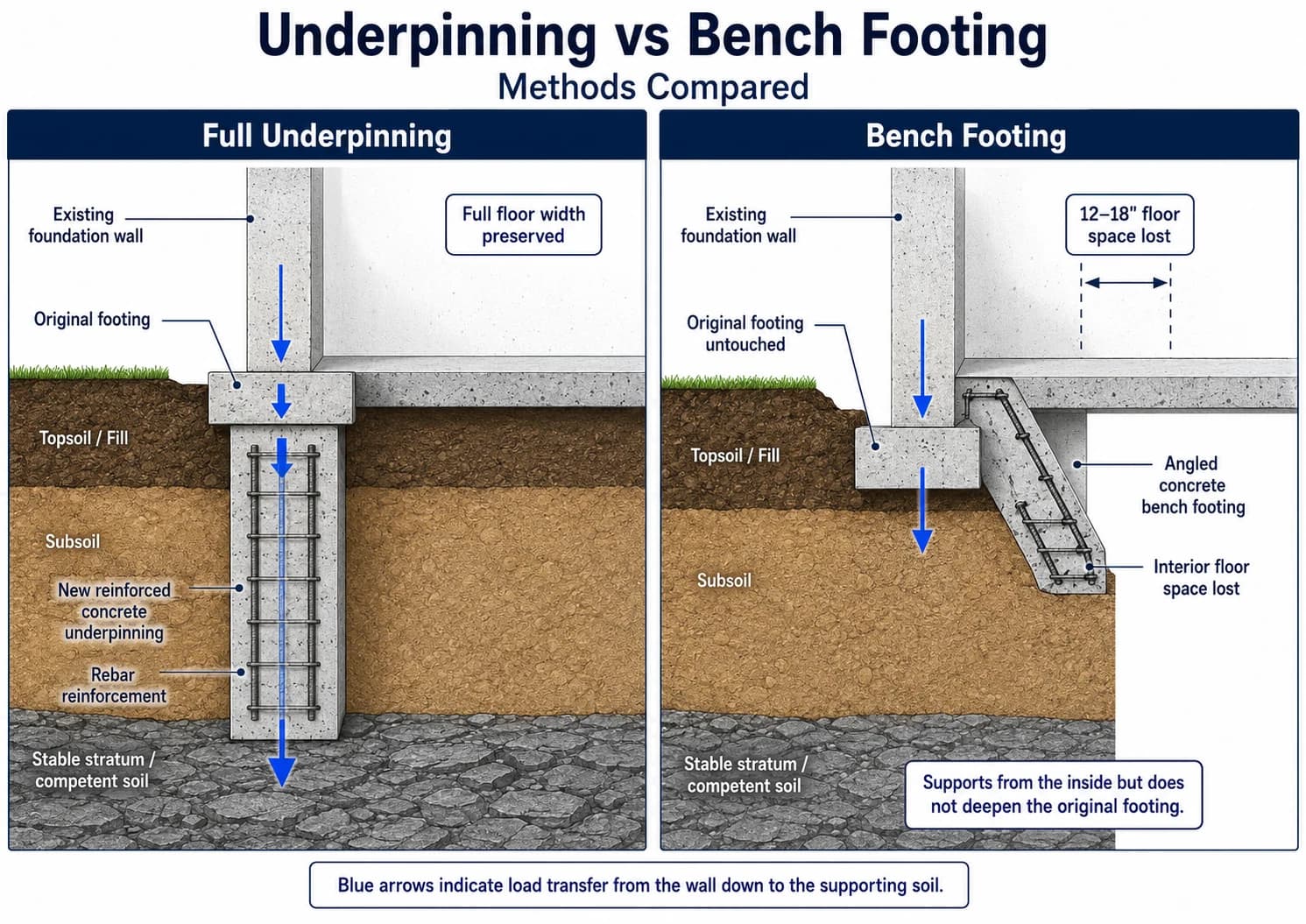
Full Underpinning
- Full floor width preserved
Bench Footing
- 12–18" floor space lost per wall
Blue arrows indicate load transfer from the wall to stable soil.
Floor Space Impact at a Glance
Mass-concrete underpinning
0 sq ft lost
Full plan preserved. Best for rental conversions and resale.
Bench footing (all 4 walls)
~75 sq ft lost on a 25×40 home
30–40% cheaper. Acceptable when budget is the priority.
Bench footing (1–2 walls only)
~20–35 sq ft lost
Hybrid approach. Common for utility or storage walls.
Choose mass-concrete when you need to maximize livable area — especially for basement apartments where every square foot affects rental value. Choose bench footing when budget is tight, only one or two walls need lowering, or the space is intended for non-living use like storage or mechanical rooms.
How We Underpin Your Whitby Home
Five core underpinning services with step-by-step process details and Whitby pricing
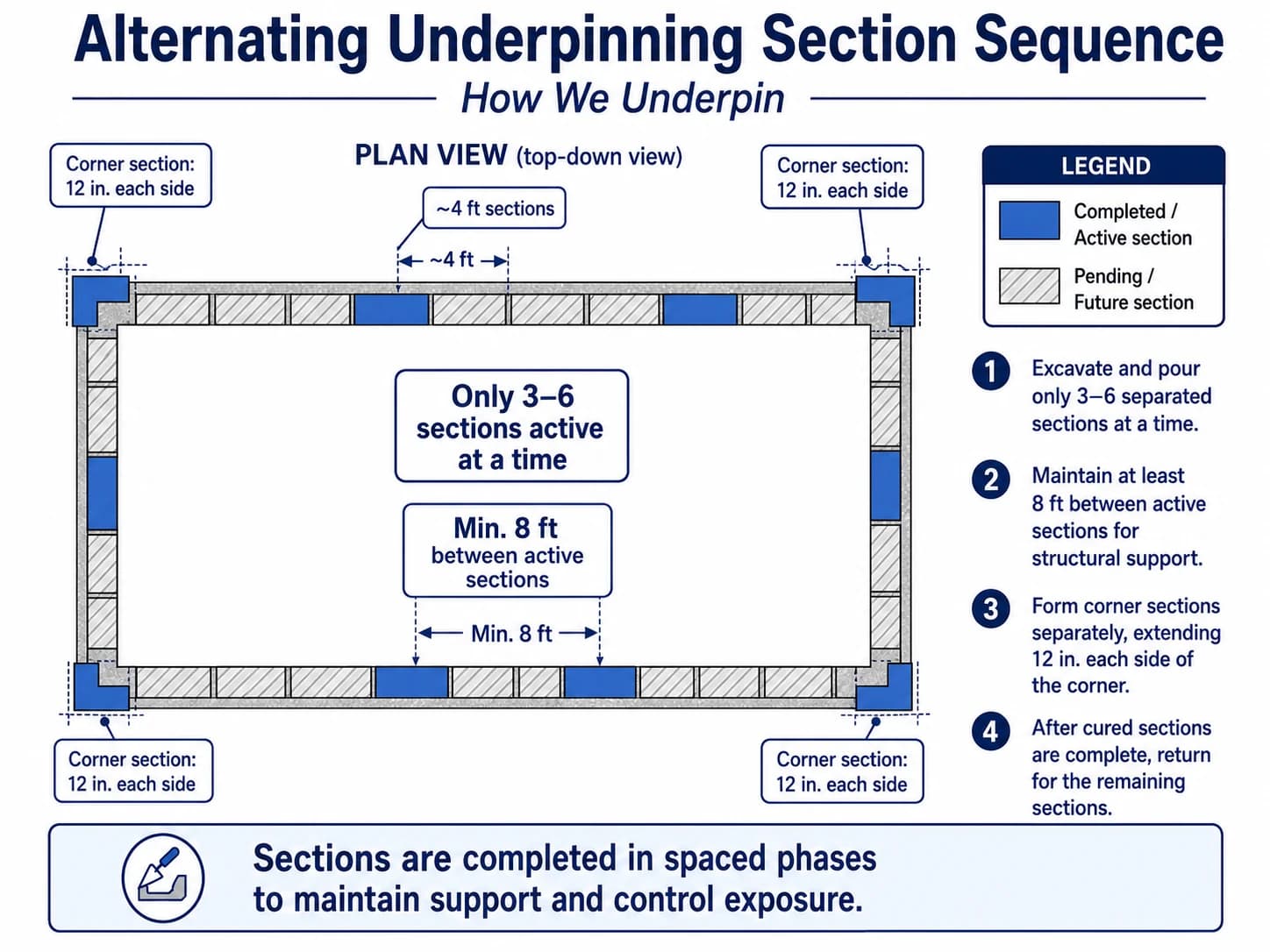
Excavate and pour alternating sections (e.g., 1, 3, 5, 7) to maintain continuous foundation support
Allow initial sections to cure for minimum 7 days before proceeding to adjacent areas
Complete remaining sections (2, 4, 6, 8) after first-phase concrete achieves structural strength
This phased approach limits exposed perimeter and ensures load paths remain intact throughout construction
Sections are completed in spaced phases to maintain support and control exposure
Bench Footing Underpinning
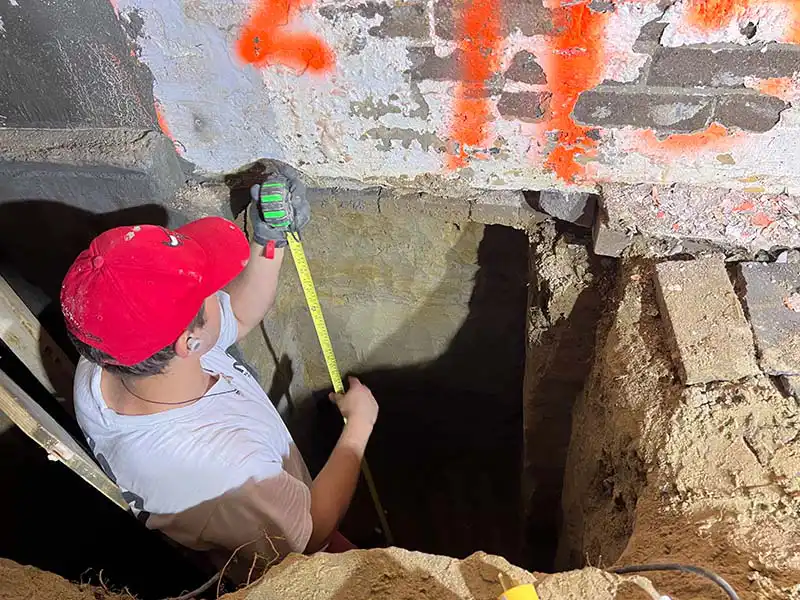
The traditional and most common method in the GTA. The existing footing is extended downward in alternating sections using reinforced concrete bench footings. Each section is excavated, formed, poured, and cured before moving to the next, ensuring the structure is supported at all times.
Process
- 1Structural engineer designs underpinning layout and sequence
- 2Obtain building permit and schedule inspections
- 3Install temporary shoring and bracing
- 4Excavate first section (max 4 ft wide) below existing footing
- 5Form and pour reinforced concrete bench footing (25-32 MPa)
- 6Allow minimum 7-day cure before loading
- 7Move to next alternating section and repeat
- 8Pour new basement floor slab with vapor barrier
- 9Final inspection by engineer and municipality
Price in Whitby
$449 – $718
Timeline
6 – 12 weeks
Full Basement Lowering
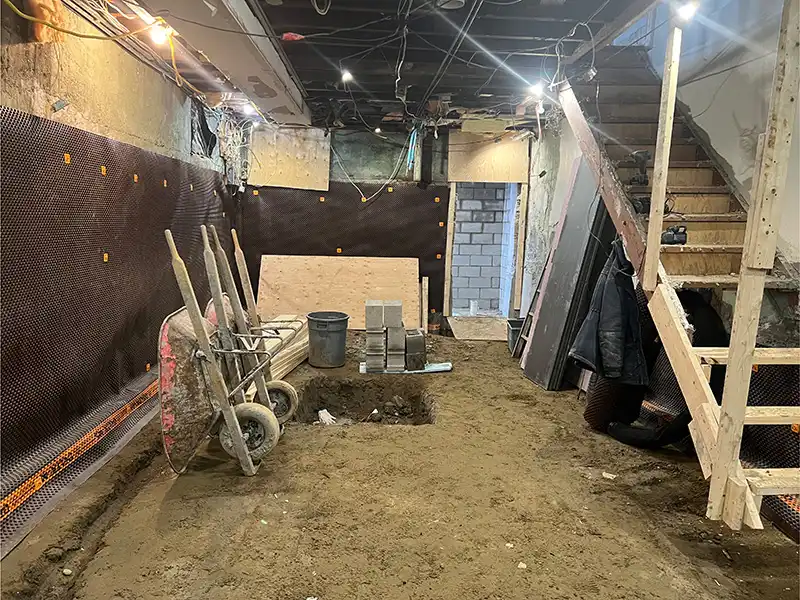
Complete basement floor lowering to gain additional ceiling height — typically from 6 ft to 8 or 9 ft. This involves underpinning all foundation walls and pouring a new floor slab at the lower elevation. The most comprehensive underpinning project, commonly done in Toronto to create legal basement apartments.
Process
- 1Geotechnical soil report and structural engineering design
- 2Building permit application with full drawings
- 3Temporary support and shoring installation
- 4Sequential underpinning of all foundation walls
- 5Excavate interior soil to new lower elevation
- 6Install interior weeping tile and sump pump system
- 7Pour new reinforced concrete floor slab
- 8Waterproofing membrane and vapor barrier
- 9HVAC, electrical, and plumbing rough-in adjustments
- 10Municipal inspections at each critical stage
Price in Whitby
$67,650 – $135,300
Timeline
8 – 16 weeks
Foundation Crack Repair & Stabilization
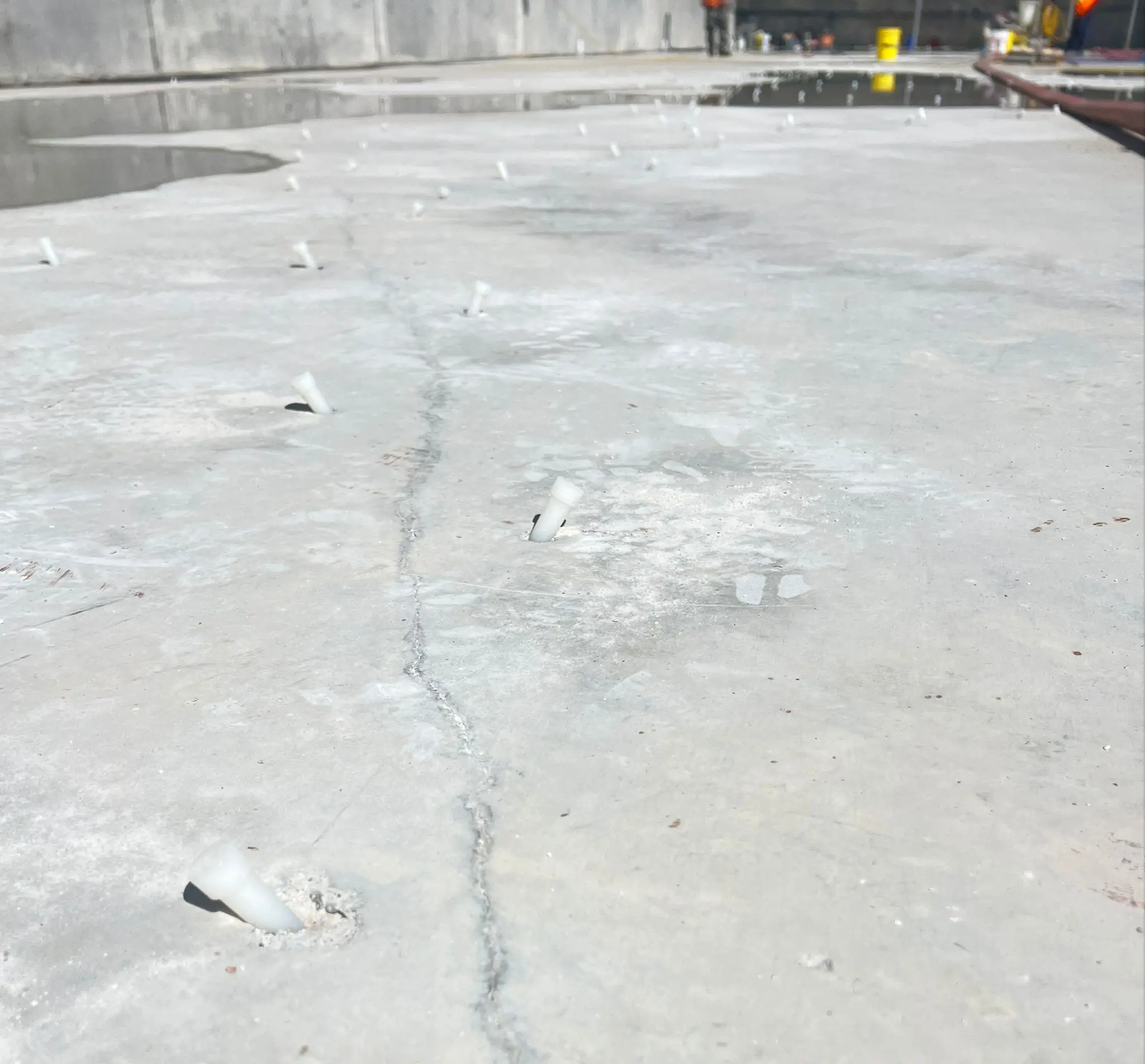
Structural cracks in foundations indicate movement that may require underpinning. Before or alongside underpinning, cracks are repaired using epoxy injection (for structural restoration) or carbon fiber straps (for wall stabilization). This prevents further movement while the foundation is being strengthened.
Process
- 1Engineer inspects crack pattern to determine cause
- 2Install crack monitors to track movement over 2-4 weeks
- 3Clean and prepare crack surfaces
- 4Install injection ports along crack length
- 5Inject structural epoxy under pressure
- 6Install carbon fiber reinforcement straps if wall is bowing
- 7Seal and finish repaired area
- 8Monitor for continued movement post-repair
Price in Whitby
$447 – $1,341
Timeline
1 – 2 days per crack
Waterproofing with Underpinning
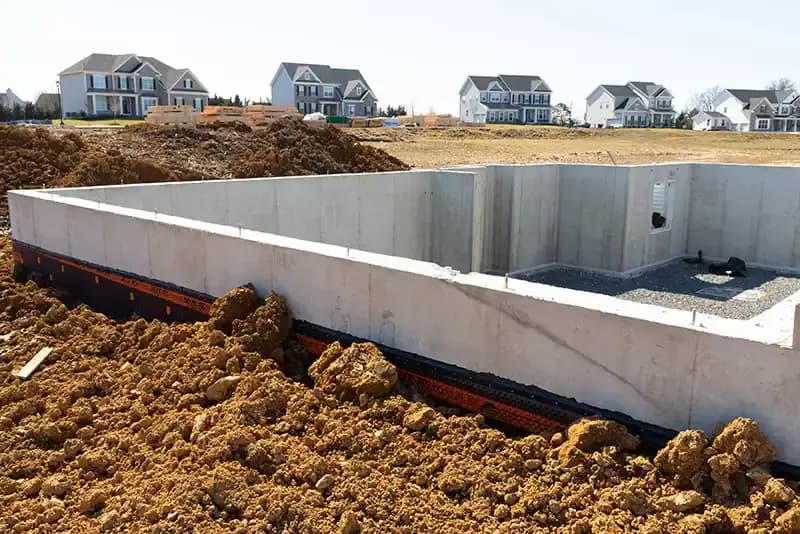
Underpinning projects expose the full foundation wall — the ideal time to add waterproofing. A rubberized membrane, dimpled drainage board, and new weeping tile are installed on the exterior wall before backfilling. Bundling waterproofing with underpinning saves 30-40% compared to doing them separately.
Process
- 1Foundation wall exposed during underpinning excavation
- 2Clean and inspect entire wall surface
- 3Repair any cracks with hydraulic cement
- 4Apply rubberized waterproofing membrane
- 5Install dimpled drainage board over membrane
- 6Lay new weeping tile wrapped in filter fabric at footing
- 7Connect weeping tile to sump pump or storm drain
- 8Backfill with clear gravel and native soil
Price in Whitby
$4,490 – $10,776
Timeline
Included in underpinning timeline
Why Whitby Homes Need Underpinning
Whitby is a rapidly growing Durham Region town where underpinning demand is rising as homeowners seek to maximize their properties. Established neighborhoods near downtown Whitby and the lakeshore have homes from the 1960s-80s with shallow basements, while the expanding Brooklin area has newer homes that homeowners are already planning to convert for rental income.
Downtown Whitby
Established downtown Whitby has 1960s-80s homes with shallow basements prime for lowering.
Brooklin Growth
Newer Brooklin homes are being proactively underpinned as homeowners plan for basement apartment income.
Lakeshore Location
South Whitby homes near Lake Ontario may face water table challenges during underpinning excavation.
Durham Value
Whitby underpinning costs about 10% below Toronto — great value with strong rental market returns.
Common Foundation Issues in Whitby
- Shallow basements in 1960s-80s downtown Whitby homes
- Growing families needing additional living space
- Brooklin homeowners planning basement conversions
- Lakefront properties with water table challenges
- Clay soil throughout established neighborhoods
- Foundation settlement near Lynde Creek and Pringle Creek
Whitby Neighborhoods We Serve
Documentation Required for Underpinning in Ontario
Underpinning is a regulated construction activity requiring professional engineering and municipal permits. Here's what's needed:
Whitby Permit Requirements
Town of Whitby requires a building permit, structural engineering drawings, and geotechnical report. Durham Region inspection standards apply.
Geotechnical Soil Report
$2,500 – $5,000A professional soil investigation ($2,500 – $5,000) determines soil bearing capacity, water table depth, and the appropriate underpinning method. Required by most municipalities.
Structural Engineering Drawings
$3,000 – $8,000Stamped drawings showing the underpinning layout, sequence, concrete specifications, rebar details, and shoring plan. Required for building permit.
Building Permit
$1,000 – $3,000Obtained from your municipality's building department. Application requires the engineering drawings, site plan, and sometimes the geotechnical report.
Site Plan
Included in engineeringA scaled drawing showing property boundaries, the home's footprint, setbacks, and the underpinning work area. Required for the building permit application.
Commitment to General Review
Included in engineeringThe structural engineer signs a commitment to inspect the work at critical stages. Required by Ontario Building Code for structural work.
Shoring Plan
Included in engineeringDetailed plan for temporary support during excavation. Ensures the home is safely supported while sections are being underpinned.
Total engineering and permit costs typically add $5,000 – $12,000 to an underpinning project. RenoNext works with licensed structural engineers and handles all permit applications.
Plan Ahead: Permit Lead Time
Engineering design + municipal permit approval typically takes 4–8 weeks before construction starts. Plan your project timeline accordingly — a spring start means applying in January or February.
Underpinning Prices in Whitby
City-adjusted pricing based on Whitby labour and material rates. Whitby pricing is approximately 10% lower than Toronto.
| Service | Price Range | Timeline |
|---|---|---|
| Bench Footing Underpinning | $449 – $718 | 6 – 12 weeks |
| Full Basement Lowering | $67,650 – $135,300 | 8 – 16 weeks |
| Foundation Crack Repair & Stabilization | $447 – $1,341 | 1 – 2 days per crack |
| Waterproofing with Underpinning | $4,490 – $10,776 | Included in underpinning timeline |
Updated June 2026. Prices are estimates based on typical GTA projects. Actual costs depend on home size, depth increase, soil conditions, and scope. See detailed cost breakdown →
Understanding Underpinning Price Quotes
Underpinning quotes use two different units, which can make it hard to compare:
Per linear foot ($/lf): Price per foot of wall being lowered — the industry standard for underpinning and bench footing quotes.
Per square foot ($/sq ft): Price per square foot of basement floor area — how some companies and real estate sites quote renovation costs.
A typical 25×40 Toronto semi-detached has ~130 linear feet of perimeter and ~1,000 sq ft of basement floor area. At $500/lf, the project cost is ~$65,000 — or about $65/sq ft. Both numbers describe the same project.
How to Finance Your Underpinning Project
Underpinning is a significant investment, but several financing strategies make it accessible — especially when rental income is part of the equation.
HELOC (Home Equity Line of Credit)
Borrow against your existing home equity with interest-only payments during construction. Typical rates are 6–7%. Most flexible option — draw only what you need, when you need it.
Cash-Out Refinance
Roll the project cost into your mortgage at a lower rate than unsecured borrowing. Works best when you have significant equity and current rates are favorable.
Milestone Payments
RenoNext bills in fixed milestones, so payments are spread across the project rather than due up front. Always compare the total cost against HELOC or refinance options.
Payback Math
At $1,800/month in rental income, a $100,000 underpinning project breaks even in approximately 4.5 years through rent alone. Factor in the $100,000–$250,000 property value increase and you're in positive equity from day one.
Underpinning FAQ — Whitby
How much does underpinning cost in Whitby?
Bench footing underpinning in Whitby costs $435 – $695 per linear foot. Full basement lowering costs $65,000 – $131,000. Whitby pricing is about 10% below Toronto.
Can I create a basement apartment in Whitby?
Yes. Durham Region permits second units in most residential zones. Underpinning to meet minimum ceiling height is the first step, followed by fire separation, separate entrance, egress windows, and mechanical work.
How long does underpinning take in Whitby?
A typical Whitby home takes 8-12 weeks for full basement lowering. Engineering and permit approvals typically take an additional 4-6 weeks before construction begins.
What's the ROI on underpinning in Whitby?
Whitby basement apartments rent for $1,400 – $1,800/month. At a project cost of $65,000 – $131,000, the payback through rental income is 4-6 years. Added property value of $100,000 – $175,000 further boosts ROI.
Do Whitby homes near creeks need special underpinning?
Homes near Lynde Creek and Pringle Creek may face higher water tables. The geotechnical report will identify any dewatering requirements, which can add $5,000 – $10,000 to the project cost.
Underpinning in Nearby Cities
RenoNext serves the entire Greater Toronto Area
Book a Free Underpinning Walkthrough in Whitby
Lower your basement with RenoNext. Engineered underpinning, fixed milestone pricing, and progress photos in your live client app.