
Underpinning in Danforth-East York, Toronto
Foundation underpinning for Danforth-East York bungalows and semi-detached homes with shared foundation expertise
Housing Profile: Danforth-East York
Understanding your neighborhood's unique housing characteristics is essential for proper underpinning planning.
Housing Stock
Danforth-East York encompasses several distinct communities (Danforth Village, Woodbine Heights, East York proper) built primarily during the 1920s-1950s post-war housing boom. The housing stock is dominated by semi-detached bungalows and 1.5-storey homes on narrow lots (20-25 feet wide). Many homes were built as working-class housing with modest finishes but solid construction. The area features consistent architectural styles (Cape Cod, minimal traditional, early ranch) with brick or brick-and-siding exteriors. Basements were typically finished as coal cellars or basic storage, with low ceilings and simple foundations.
Era Range
1920s-1950s (interwar and post-war period)
Foundation Types
Predominantly poured concrete foundations (1920s onward), with some concrete block foundations from the 1940s-1950s. Earlier 1920s homes may have poured concrete over earlier rubble stone bases. Post-war homes (1945-1955) typically have standardized 8-inch poured concrete walls. Shared foundations are extremely common in semi-detached configurations.
Typical Ceiling Height
5'10" to 6'6" - Most homes have basement ceiling heights between 6'0" and 6'4", which is slightly better than older Toronto neighborhoods but still below modern standards. Earlier 1920s homes may be as low as 5'10", while late 1940s-1950s homes sometimes reach 6'6". Many homeowners pursue underpinning to reach 7'0"+ for legal basement apartment height.
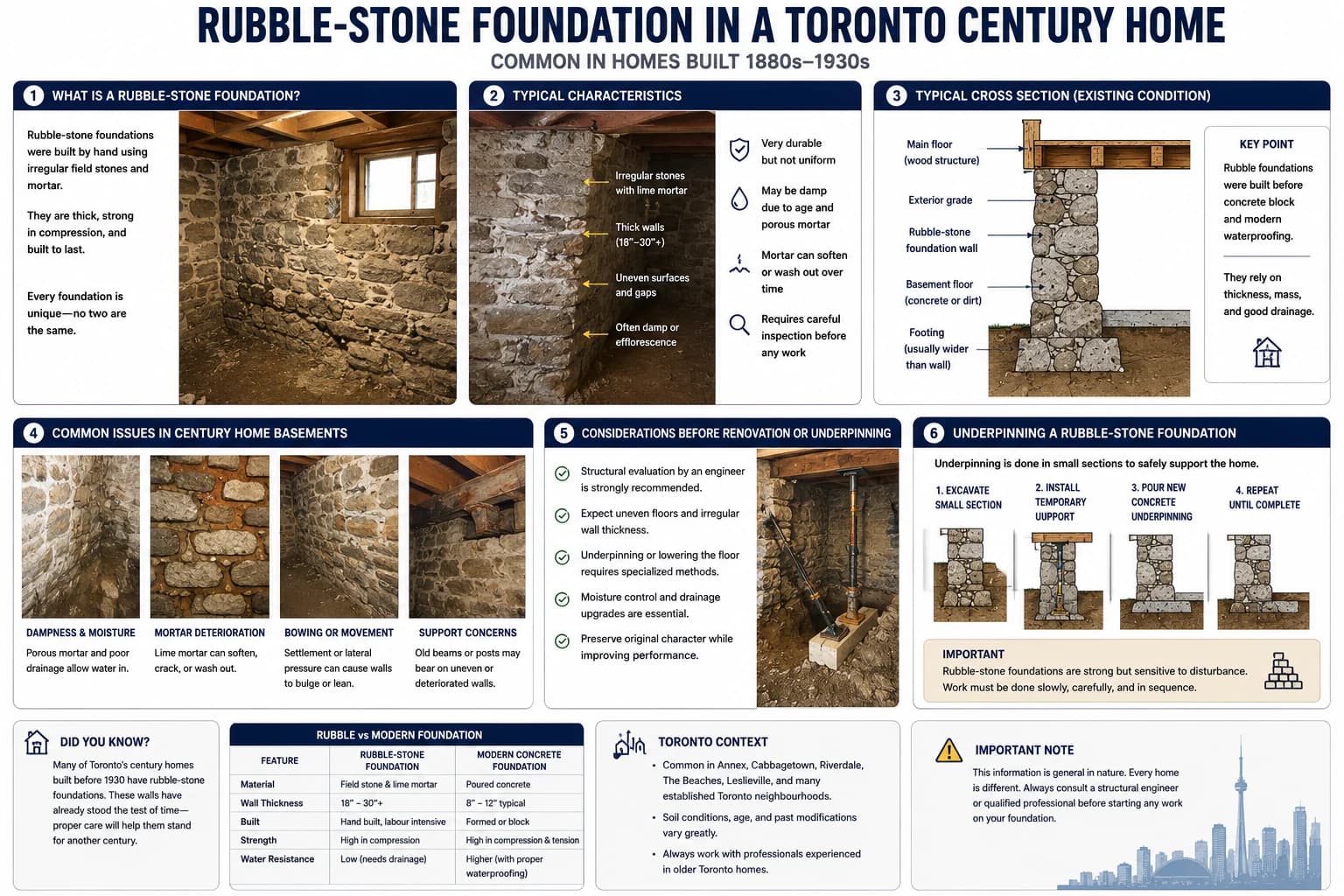
What Is a Rubble-Stone Foundation?
Rubble-stone foundations were built by hand using irregular field stones and lime mortar. They are thick, strong in compression, and built to last. Common in homes built between 1880s–1930s, every foundation is unique — no two are the same.
Common Issues
Dampness
Porous mortar and poor drainage allow water in
Mortar Deterioration
Lime mortar can soften, crack, or wash out
Bowing
Settlement or lateral pressure can cause walls to bulge
Support Concerns
Old beams may bear on uneven or deteriorated walls
Before Renovation — 5 Key Checks
- 1.Structural evaluation by an engineer is strongly recommended
- 2.Expect uneven floors and irregular wall thickness
- 3.Underpinning or lowering the floor requires specialized methods
- 4.Moisture control and drainage upgrades are essential
- 5.Preserve original character while improving performance
Comparison: Rubble-Stone vs Modern Concrete
| Feature | Rubble-Stone | Modern Concrete |
|---|---|---|
| Material | Field stone + lime mortar | Poured/block concrete |
| Wall Thickness | 18"–30"+ | 8"–12" typical |
| Water Resistance | Low (needs drainage) | Higher (with proper waterproofing) |
| Strength | High in compression | High in compression & tension |
| Built method | Hand built, labour intensive | Formed or block |
Toronto Context
Common in Annex, Cabbagetown, Riverdale, The Beaches, Leslieville, and many established Toronto neighbourhoods. Soil conditions, age, and past modifications vary greatly. Always work with professionals experienced in older Toronto homes.
IMPORTANT NOTE
This information is general in nature. Every home is different. Always consult a structural engineer or qualified professional before starting any work on your foundation.
Soil Conditions & Local Challenges
Every Toronto neighborhood has unique geological characteristics that affect underpinning projects.
Soil Conditions
Heavy clay soil with poor drainage in low-lying areas, particularly near the Don Valley and small creek tributaries. The area has relatively flat topography, which can lead to water accumulation during heavy rain. Older drainage infrastructure (many homes still have clay tile weeping tiles from the 1920s-1950s) is often inadequate. High clay content provides good load-bearing capacity but requires robust waterproofing and modern drainage systems. Areas north of Danforth Avenue generally have better drainage than low areas south of the railway corridor.
Common Challenges
- Tight semi-detached lot configurations with limited side access (often 2-4 feet between homes)
- Shared foundations between semi-detached units requiring neighbor notification and coordination
- Older clay weeping tile systems failing and requiring complete replacement
- Heavy clay soil and poor drainage in low-lying areas requiring robust waterproofing
- Post-war concrete block foundations requiring different underpinning approaches than poured concrete
- Underground electrical and utility lines from 1920s-1950s requiring careful mapping before excavation
- Party wall structural considerations where foundations are truly shared
Project Scope & Pricing
What to expect for underpinning projects in Danforth-East York.
Typical Project Scope
Most Danforth-East York underpinning projects involve increasing basement ceiling height from 6'0"-6'4" to 7'0"-7'6" to create legal basement apartments. Given the area's working-class roots and current gentrification, many homeowners pursue underpinning to generate rental income. Full-perimeter underpinning is standard, often combined with foundation waterproofing, weeping tile replacement, and installation of modern sump pump systems. For semi-detached homes, coordination with neighbors regarding shared foundations is essential, though underpinning can be done on one side only if necessary.
Pricing Context
Underpinning costs in Danforth-East York range from $75,000-$125,000 for typical projects. The area tends toward the lower end of Toronto pricing due to smaller home footprints and better access than downtown neighborhoods. Full-perimeter underpinning for semi-detached bungalows (20-25 feet wide) averages $75,000-$95,000. Detached homes (25-30 feet) average $85,000-$110,000. Shared foundation considerations can add $5,000-$10,000 for structural engineering and coordination. Poor drainage and older weeping tile systems often require comprehensive waterproofing, adding $10,000-$15,000. Despite costs, the strong rental market makes basement apartments highly profitable for homeowners.
Frequently Asked Questions
Common questions about underpinning in Danforth-East York
Do I need my neighbor's permission to underpin my semi-detached home in Danforth-East York?
Legally, you do not need your neighbor's permission to underpin your own foundation, but you do need to notify them and follow proper procedures. Most semi-detached homes in Danforth-East York have shared central walls but separate foundations on each side. However, some older homes have truly shared foundations where both units rest on the same footing. A structural engineer will assess your specific situation during the planning phase. Best practice is to notify your neighbor in writing, share engineering reports, and provide advance notice of construction schedules. If your neighbor is also considering underpinning, coordinating projects can reduce costs for both parties. In rare cases where foundations are truly shared, you may need party wall agreements or additional engineering to ensure your work doesn't compromise your neighbor's structure.
What are the benefits of underpinning a bungalow in Danforth-East York?
Underpinning a Danforth-East York bungalow offers multiple benefits. First, it creates legal basement apartment space with 7'0"+ ceiling height, generating $1,800-$2,500/month in rental income in this high-demand area. Second, it addresses foundation issues common in 1920s-1950s homes: settling cracks, water infiltration, and inadequate drainage. Third, it significantly increases property value - typically $120,000-$180,000 added value for a well-executed basement apartment conversion. Fourth, it allows multi-generational living arrangements (in-law suite, adult children). Fifth, it provides peace of mind with a modern, structurally sound foundation meeting current building codes. Given modest purchase prices compared to downtown Toronto ($900,000-$1.4M), the investment in underpinning yields strong returns.
How does poor drainage in East York affect underpinning projects?
Poor drainage is a significant concern in Danforth-East York, particularly in low-lying areas. Heavy clay soil retains water, and many homes still have original 1920s-1950s clay tile weeping systems that have failed. During underpinning, comprehensive drainage upgrades are essential. This includes installing new perforated weeping tile around the full foundation perimeter, connecting to storm sewers or sump pump systems, and applying modern waterproofing membranes. In flood-prone areas, we may recommend interior French drains or additional sump pump capacity. Poor drainage adds $10,000-$18,000 to typical underpinning projects but is not optional - underpinning without proper drainage invites water problems afterward. The good news is that modern drainage systems, combined with underpinning, permanently solve chronic basement water issues common in this area.
Can concrete block foundations in post-war East York homes be underpinned safely?
Yes, but concrete block foundations (common in 1940s-1950s homes) require different approaches than poured concrete. Concrete block is more brittle and can crack under stress, so underpinning must be done in smaller sections with careful shoring. The process takes slightly longer, and engineering oversight is critical to prevent block failure. We typically use steel reinforcement and pin new footings securely to existing block walls. In some cases, we may recommend reinforcing the block walls with shotcrete or additional internal bracing before underpinning. Block foundation underpinning adds 10-15% to project costs compared to poured concrete, but it's absolutely feasible. Many East York homes have been successfully underpinned despite block foundations. A structural engineer will assess your specific foundation condition and recommend appropriate methods.
Is underpinning worth it for creating a rental apartment in Danforth-East York?
Extremely worthwhile. Danforth-East York has strong rental demand due to proximity to downtown (15-20 minutes via TTC), walkable Danforth Avenue with restaurants and shops, and relatively affordable rents compared to downtown. A legal 2-bedroom basement apartment rents for $1,800-$2,400/month, generating $21,600-$28,800 annual income. With typical underpinning costs of $75,000-$95,000 plus $30,000-$45,000 for apartment finishing, total investment is $105,000-$140,000. At $2,200/month average rent, you recoup costs in 4-5 years through rental income alone. Additionally, property value increases by $120,000-$180,000, creating immediate equity. The neighborhood is gentrifying, with young families and professionals driving rental demand. Many homeowners use rental income to cover mortgage costs, making home ownership more affordable. From both cash flow and property value perspectives, underpinning for a rental apartment is one of the best investments you can make in this area.
Related Resources
Explore more about underpinning in Toronto
Best Underpinning Services in Toronto
How we run underpinning projects across Toronto — our crew, our methods, and what every job includes.
Complete Underpinning Process Guide
Step-by-step visual guide to understanding the underpinning process from start to finish.
Underpinning Costs in Toronto
Detailed cost breakdown and pricing factors for underpinning projects in the Toronto area.
Underpinning vs Bench Footing
Compare foundation lowering methods and determine which approach is right for your project.
Ready to Start Your Underpinning Project in Danforth-East York?
We know Danforth-East York's housing stock and soil conditions. Book a free walkthrough — no obligation — and follow every step of the work in our live client app.
Licensed & Insured
WSIB covered, fully insured, and licensed under the OBC
Local Expertise
Familiar with Danforth-East York's soil conditions and building requirements
Live Client App
Crew, costs, photos and inspections visible on every project