
Underpinning in High Park-Swansea, Toronto
Foundation underpinning specialists for High Park-Swansea heritage homes and century properties
Housing Profile: High Park-Swansea
Understanding your neighborhood's unique housing characteristics is essential for proper underpinning planning.
Housing Stock
High Park-Swansea features predominantly century character homes built between 1900-1940, with distinctive architectural styles including Arts & Crafts, Edwardian, and early Colonial Revival. The area has pockets of post-war bungalows along side streets, but the dominant housing stock consists of 1.5 to 2.5-storey detached and semi-detached homes on narrow lots (25-30 feet wide). These homes were built for middle-class families and feature quality construction that has largely stood the test of time, though basements reflect early 20th-century standards.
Era Range
1900s-1940s (predominantly pre-WWI and interwar period)
Foundation Types
Rubble stone foundations (1900s-1920s), early poured concrete (1920s-1940s), with some brick foundations in the oldest homes. Many homes have mixed foundation systems where earlier rubble stone was patched or reinforced with concrete during mid-century renovations.
Typical Ceiling Height
5'8" to 6'4" - Most century homes in this area have basement ceiling heights between 5'10" and 6'2", with some older homes as low as 5'8" and later 1930s-1940s homes reaching 6'4". The variation depends on original construction standards and lot grading.
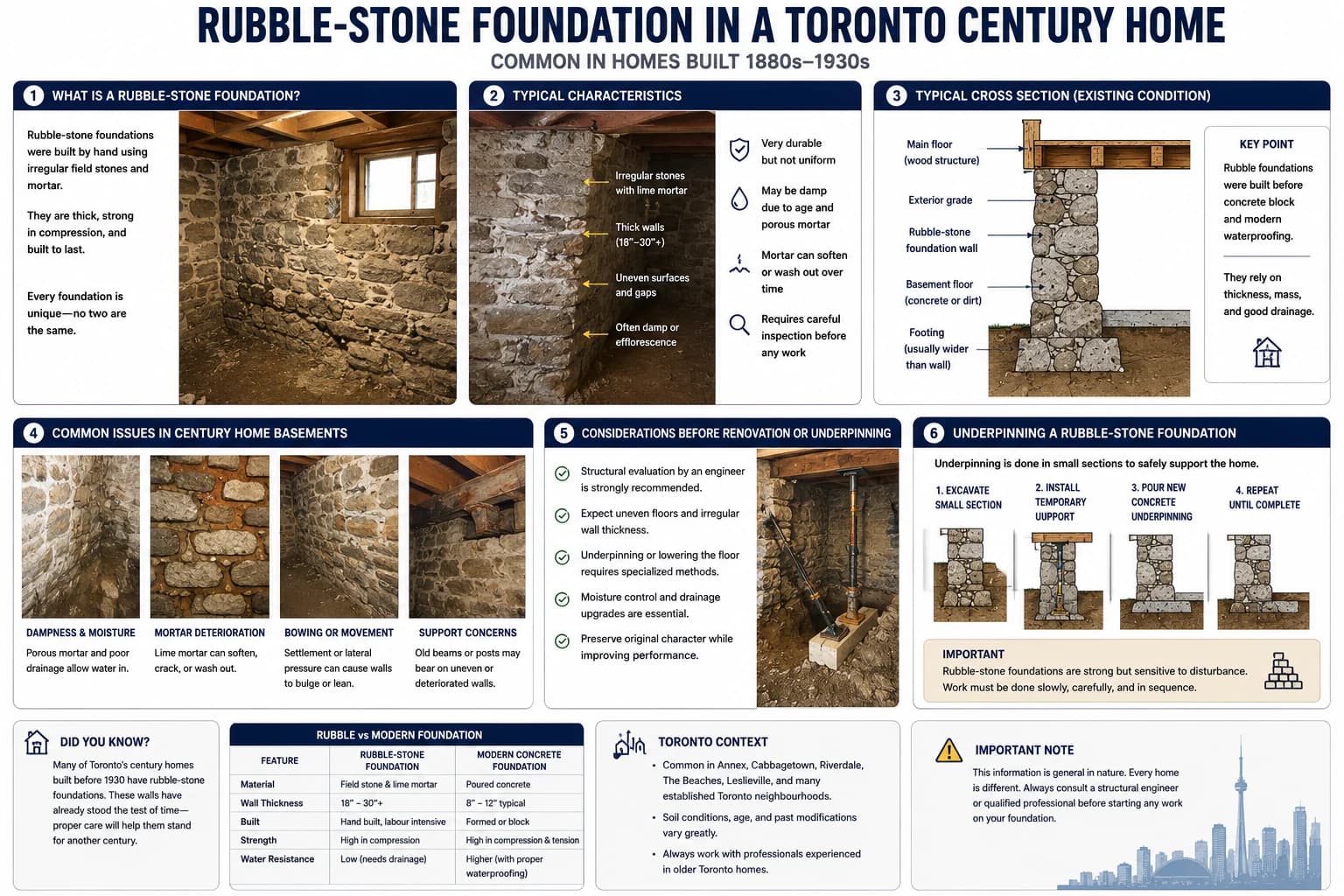
What Is a Rubble-Stone Foundation?
Rubble-stone foundations were built by hand using irregular field stones and lime mortar. They are thick, strong in compression, and built to last. Common in homes built between 1880s–1930s, every foundation is unique — no two are the same.
Common Issues
Dampness
Porous mortar and poor drainage allow water in
Mortar Deterioration
Lime mortar can soften, crack, or wash out
Bowing
Settlement or lateral pressure can cause walls to bulge
Support Concerns
Old beams may bear on uneven or deteriorated walls
Before Renovation — 5 Key Checks
- 1.Structural evaluation by an engineer is strongly recommended
- 2.Expect uneven floors and irregular wall thickness
- 3.Underpinning or lowering the floor requires specialized methods
- 4.Moisture control and drainage upgrades are essential
- 5.Preserve original character while improving performance
Comparison: Rubble-Stone vs Modern Concrete
| Feature | Rubble-Stone | Modern Concrete |
|---|---|---|
| Material | Field stone + lime mortar | Poured/block concrete |
| Wall Thickness | 18"–30"+ | 8"–12" typical |
| Water Resistance | Low (needs drainage) | Higher (with proper waterproofing) |
| Strength | High in compression | High in compression & tension |
| Built method | Hand built, labour intensive | Formed or block |
Toronto Context
Common in Annex, Cabbagetown, Riverdale, The Beaches, Leslieville, and many established Toronto neighbourhoods. Soil conditions, age, and past modifications vary greatly. Always work with professionals experienced in older Toronto homes.
IMPORTANT NOTE
This information is general in nature. Every home is different. Always consult a structural engineer or qualified professional before starting any work on your foundation.
Soil Conditions & Local Challenges
Every Toronto neighborhood has unique geological characteristics that affect underpinning projects.
Soil Conditions
Predominantly clay soil with relatively good drainage toward the Humber River valley to the west. The area sits on higher ground than many Toronto neighborhoods, which helps with water management. However, pockets near Bloor Street and low-lying areas can experience water accumulation during heavy rain. The clay content means good load-bearing capacity but requires proper drainage systems to prevent hydrostatic pressure against foundations.
Common Challenges
- Narrow lot access between homes (often 3-4 feet) requiring hand excavation or small equipment
- Century home foundations with rubble stone requiring careful assessment and reinforcement
- Mature tree roots from street trees and large backyard trees interfering with excavation
- Heritage property designations requiring Toronto Heritage Preservation Services approval for some homes
- Mixed foundation systems where different eras and materials meet, requiring specialized approaches
- Party wall considerations for semi-detached homes built with shared foundations
- Underground streams or water table fluctuations near ravine slopes toward High Park
Project Scope & Pricing
What to expect for underpinning projects in High Park-Swansea.
Typical Project Scope
Most High Park-Swansea underpinning projects involve increasing basement ceiling height from 5'10"-6'0" to 7'0"-7'6" to create functional living space. Full-perimeter underpinning is common due to the age of foundations and the desire to address multiple issues simultaneously (height, cracks, water infiltration). Projects typically include foundation waterproofing, weeping tile replacement, and sump pump installation. Many homeowners combine underpinning with basement lowering to maximize headroom.
Pricing Context
Underpinning costs in High Park-Swansea range from $75,000-$135,000 for typical projects. Full-perimeter underpinning averages $85,000-$110,000 for standard semi-detached homes (20-25 feet wide) and $95,000-$135,000 for larger detached homes (25-30 feet wide). Premium pricing factors include narrow lot access requiring hand excavation, mature tree roots requiring root pruning or specialized equipment, and heritage home considerations. The neighborhood's desirability and property values justify investment in proper underpinning to create rentable basement suites or additional living space.
Frequently Asked Questions
Common questions about underpinning in High Park-Swansea
Can I underpin a century home in High Park-Swansea without damaging its character?
Yes. Modern underpinning techniques preserve the structural integrity and architectural character of century homes. The work is done entirely below grade, so exterior facades and heritage details remain untouched. We work with structural engineers who specialize in heritage properties to ensure appropriate methods are used. For homes with heritage designation, we coordinate with Toronto Heritage Preservation Services and provide documentation for approval. The key is proper assessment of your existing rubble stone or early concrete foundation and choosing underpinning methods that respect the original construction while meeting modern building codes.
How does narrow lot access in High Park-Swansea affect underpinning costs?
Narrow side yards (3-4 feet between homes) significantly impact costs because excavation equipment cannot access the backyard. This requires either hand excavation or specialized small equipment, increasing labor time by 30-50%. For a typical semi-detached home, narrow access adds $8,000-$15,000 to project costs. We assess access during the free walkthrough and provide specific costs. Some homeowners coordinate with neighbors for temporary fence removal to improve access. In cases where backyard access is impossible, all materials must be hand-carried through the home, adding further complexity. Despite higher costs, underpinning is still worthwhile given High Park-Swansea property values and the value added by additional living space.
What foundation issues are most common in High Park-Swansea homes built before 1920?
Pre-1920 homes in High Park-Swansea typically have rubble stone foundations with lime mortar, which deteriorates over time. Common issues include: mortar erosion causing loose stones and water infiltration; settling cracks from over 100 years of soil movement; inadequate drainage systems allowing hydrostatic pressure buildup; and insufficient ceiling height (often 5'8"-6'0") for modern use. Many homes also have mixed foundation materials where repairs were made with concrete in the 1950s-1970s, creating joints that can develop cracks. A structural engineer should assess the foundation before underpinning to identify weak points. Full-perimeter underpinning addresses these issues comprehensively while creating usable basement space.
Do mature trees in High Park-Swansea interfere with underpinning projects?
Yes, mature trees are a significant consideration. High Park-Swansea has extensive tree canopy from large street trees (often 50-80 years old) and backyard trees. Root systems can extend 1.5-2 times the canopy width, often reaching beneath foundations. During underpinning, we encounter roots that must be carefully managed. We work with arborists to assess tree health and determine which roots can be pruned without harming the tree. Root barriers may be installed to prevent future foundation damage. In rare cases, city permits are required for street tree root pruning. Factor in $2,000-$5,000 for arborist consultation and root management for properties with large trees. The good news is that proper underpinning and drainage improvements often protect trees by preventing soil erosion and managing water better.
Is underpinning worth it in High Park-Swansea given the high cost?
Absolutely. High Park-Swansea is one of Toronto's most desirable neighborhoods with strong property values ($1.2M-$2.5M for typical homes). Underpinning to create a legal basement apartment or additional living space adds $100,000-$200,000 in property value, well above the $85,000-$135,000 typical project cost. Beyond financial returns, underpinning solves chronic foundation issues common in century homes, preventing costly emergency repairs later. Many homeowners underpin to create rental income (helping with mortgage costs) or to accommodate multi-generational living. The neighborhood's walkability, parks, schools, and transit access make maximizing your home's square footage a smart investment. We work on century homes like these across Toronto's west end, so the quirks of this housing stock are familiar territory.
Related Resources
Explore more about underpinning in Toronto
Best Underpinning Services in Toronto
How we run underpinning projects across Toronto — our crew, our methods, and what every job includes.
Complete Underpinning Process Guide
Step-by-step visual guide to understanding the underpinning process from start to finish.
Underpinning Costs in Toronto
Detailed cost breakdown and pricing factors for underpinning projects in the Toronto area.
Underpinning vs Bench Footing
Compare foundation lowering methods and determine which approach is right for your project.
Ready to Start Your Underpinning Project in High Park-Swansea?
We know High Park-Swansea's housing stock and soil conditions. Book a free walkthrough — no obligation — and follow every step of the work in our live client app.
Licensed & Insured
WSIB covered, fully insured, and licensed under the OBC
Local Expertise
Familiar with High Park-Swansea's soil conditions and building requirements
Live Client App
Crew, costs, photos and inspections visible on every project