
Underpinning in Leslieville, Toronto
Foundation underpinning for Leslieville heritage cottages and semi-detached homes with high water table expertise
Housing Profile: Leslieville
Understanding your neighborhood's unique housing characteristics is essential for proper underpinning planning.
Housing Stock
Leslieville was historically a working-class neighborhood built to house factory workers and tradespeople from the nearby industrial areas along the Don River and rail corridor. The housing stock consists primarily of workers' cottages and semi-detached homes built between 1890-1930. These are modest 1 to 1.5-storey homes on narrow lots (15-20 feet wide for cottages, 20-25 feet for semi-detached), built quickly and economically with simple designs. Despite their modest origins, many homes feature charming details like bay windows, decorative brickwork, and front porches. The neighborhood has undergone significant gentrification since the 2000s, with young families and professionals purchasing and renovating these character homes.
Era Range
1890s-1930s (late Victorian through interwar period)
Foundation Types
Predominantly rubble stone foundations (1890s-1910s) and early poured concrete (1910s-1930s). Workers' cottages typically have more basic foundations than higher-end neighborhoods, with thinner walls and simpler construction. Some homes have brick foundations, particularly the oldest ones from the 1890s. Many foundations show signs of settlement, cracking, and water damage due to the high water table and proximity to the Don River.
Typical Ceiling Height
5'8" to 6'4" - Most Leslieville homes have basement ceiling heights between 5'10" and 6'2", with workers' cottages on the lower end and later semi-detached homes (1920s-1930s) on the higher end. The modest construction standards mean ceilings are often irregular, with ducts, beams, and pipes reducing effective height. Many homeowners pursue underpinning to achieve 7'0"-7'6" ceilings for legal basement apartments.
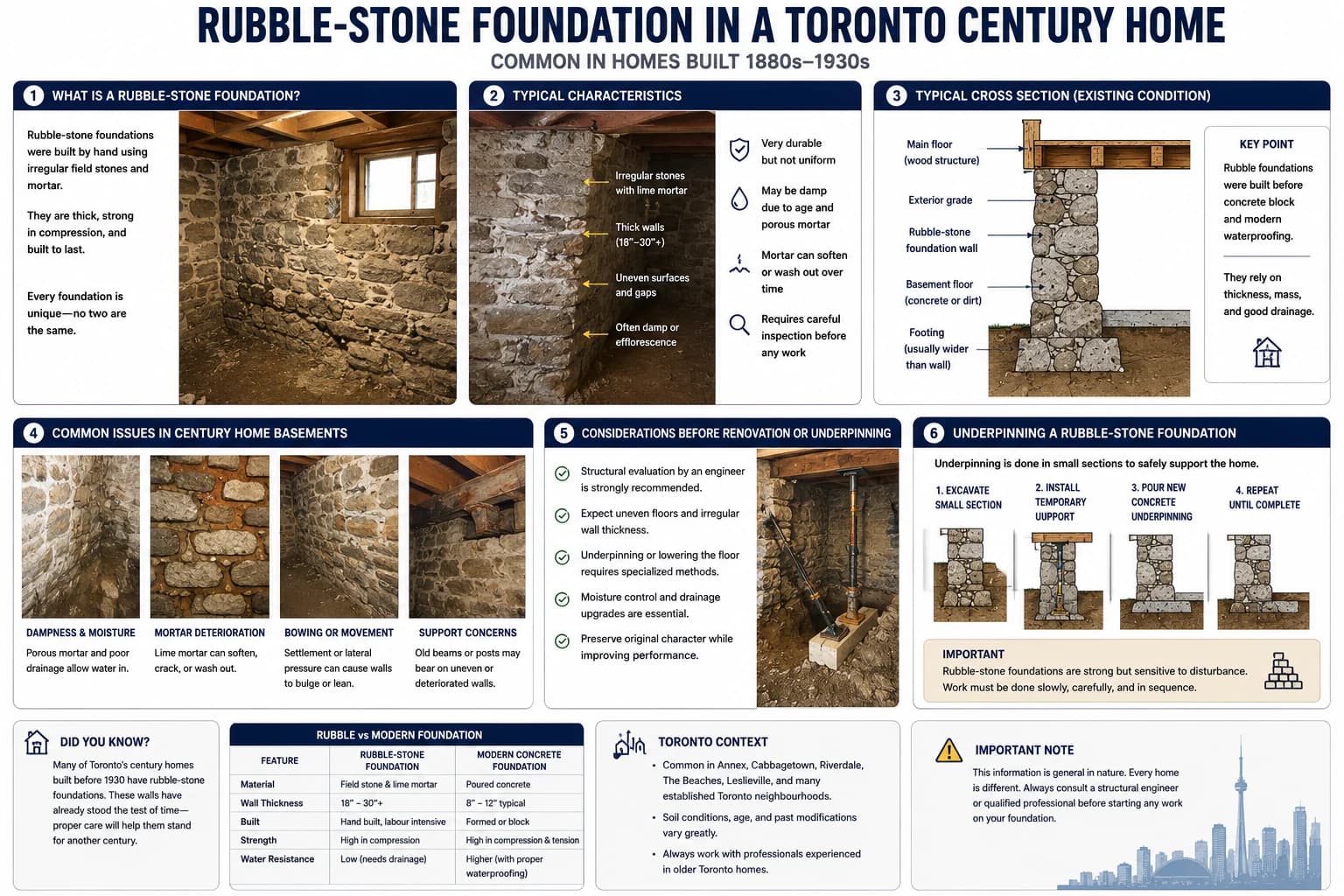
What Is a Rubble-Stone Foundation?
Rubble-stone foundations were built by hand using irregular field stones and lime mortar. They are thick, strong in compression, and built to last. Common in homes built between 1880s–1930s, every foundation is unique — no two are the same.
Common Issues
Dampness
Porous mortar and poor drainage allow water in
Mortar Deterioration
Lime mortar can soften, crack, or wash out
Bowing
Settlement or lateral pressure can cause walls to bulge
Support Concerns
Old beams may bear on uneven or deteriorated walls
Before Renovation — 5 Key Checks
- 1.Structural evaluation by an engineer is strongly recommended
- 2.Expect uneven floors and irregular wall thickness
- 3.Underpinning or lowering the floor requires specialized methods
- 4.Moisture control and drainage upgrades are essential
- 5.Preserve original character while improving performance
Comparison: Rubble-Stone vs Modern Concrete
| Feature | Rubble-Stone | Modern Concrete |
|---|---|---|
| Material | Field stone + lime mortar | Poured/block concrete |
| Wall Thickness | 18"–30"+ | 8"–12" typical |
| Water Resistance | Low (needs drainage) | Higher (with proper waterproofing) |
| Strength | High in compression | High in compression & tension |
| Built method | Hand built, labour intensive | Formed or block |
Toronto Context
Common in Annex, Cabbagetown, Riverdale, The Beaches, Leslieville, and many established Toronto neighbourhoods. Soil conditions, age, and past modifications vary greatly. Always work with professionals experienced in older Toronto homes.
IMPORTANT NOTE
This information is general in nature. Every home is different. Always consult a structural engineer or qualified professional before starting any work on your foundation.
Soil Conditions & Local Challenges
Every Toronto neighborhood has unique geological characteristics that affect underpinning projects.
Soil Conditions
Clay soil with a high water table due to proximity to the Don River (4-8 blocks east). The area is relatively flat and low-lying, leading to chronic drainage issues. Many properties experience basement water infiltration, especially during spring thaw and heavy rain. The high water table means groundwater is often 3-6 feet below grade, requiring robust waterproofing and sump pump systems. Soil load-bearing capacity is adequate for residential construction, but the moisture content creates ongoing challenges.
Common Challenges
- High water table requiring robust waterproofing, sump pumps, and ongoing water management
- Narrow lot configurations (15-20 feet for cottages) with limited or no side access for equipment
- Party wall considerations for semi-detached homes with shared foundations
- Rubble stone and brick foundations showing settlement and deterioration from water damage
- Proximity to Don River creating localized flooding risk and groundwater fluctuations
- Gentrification-driven high property costs creating pressure to maximize return on investment
- Mature street trees with extensive root systems interfering with excavation
Project Scope & Pricing
What to expect for underpinning projects in Leslieville.
Typical Project Scope
Most Leslieville underpinning projects focus on increasing basement ceiling height from 5'10"-6'2" to 7'0"-7'6" to create legal basement apartments. The neighborhood's gentrification and high demand for rental housing drive many projects. Full-perimeter underpinning is standard, always combined with comprehensive waterproofing, weeping tile replacement, and sump pump installation (critical due to high water table). For narrow workers' cottages (15-20 feet wide), projects are somewhat smaller in scope than wider homes. Many homeowners tackle underpinning as part of full-home renovations, modernizing properties purchased at premium prices.
Pricing Context
Underpinning costs in Leslieville range from $75,000-$130,000 depending on home size. Workers' cottages (15-20 feet wide) average $75,000-$90,000 for full-perimeter underpinning, while semi-detached homes (20-25 feet) average $80,000-$105,000. High water table management adds $12,000-$18,000 for comprehensive waterproofing, interior drainage, and sump systems. Narrow lots and party wall considerations are common. Despite costs, the investment is justified by Leslieville property values ($1.1M-$1.8M) and strong rental demand ($1,900-$2,600/month for basement apartments). The neighborhood's Queen East location, restaurants, shops, and parks make it highly desirable, supporting premium renovation investments.
Frequently Asked Questions
Common questions about underpinning in Leslieville
How does the high water table in Leslieville affect underpinning projects?
The high water table in Leslieville is a critical consideration. Groundwater is often 3-6 feet below grade, meaning underpinning excavations frequently encounter water. During underpinning, we use dewatering pumps to manage groundwater infiltration, which adds time and cost to projects. After underpinning, comprehensive waterproofing is mandatory - we apply heavy-duty waterproofing membranes, install new perforated weeping tile systems, and connect to high-capacity sump pumps (often dual-pump systems for redundancy). Interior French drains may be recommended for properties with severe water issues. High water table management adds $12,000-$18,000 to typical projects, but it's not optional. Properties underpinned without proper water management will experience chronic flooding. The good news is that modern waterproofing systems, combined with underpinning, permanently solve the basement water problems common in this area. Many Leslieville homeowners report dry basements for the first time after underpinning.
Can workers' cottages in Leslieville be underpinned despite their small size and narrow lots?
Yes, workers' cottages are excellent candidates for underpinning despite challenges. The narrow lots (15-20 feet) and small footprints mean lower total costs ($75,000-$90,000) compared to larger homes. However, narrow side yards (often 2-4 feet or no side access at all) require hand excavation or materials carried through the house, which increases labor costs. We assess access during the initial walkthrough. Despite small size, underpinning adds enormous value - a 15-foot-wide cottage gains 400-500 sq ft of functional basement space, perfect for a 1-bedroom basement apartment renting for $1,700-$2,200/month. Given cottage purchase prices ($1.0M-$1.4M), the investment in underpinning is justified. Many gentrified cottages on Leslieville streets have been successfully underpinned, and we know these tight-access conditions well. The key is proper planning, realistic budgets, and understanding that access constraints will affect timelines.
What foundation problems are most common in Leslieville homes near the Don River?
Leslieville homes within 10 blocks of the Don River commonly experience foundation issues related to water and soil moisture. The most frequent problems include: chronic basement water infiltration from high groundwater; foundation cracks from soil expansion and contraction with moisture fluctuations; deteriorated mortar in rubble stone foundations from constant moisture exposure; settling and shifting from inadequate footings by modern standards; failed or never-installed weeping tile systems; mold and moisture damage to interior basement finishes. Many homes have undergone multiple patching attempts over the decades, but without comprehensive solutions, problems persist. Underpinning addresses these issues holistically - new deep footings on stable soil, full waterproofing, modern drainage systems, and structural repairs. While not cheap, it's the permanent solution to chronic problems that would otherwise require ongoing maintenance and emergency repairs.
Is underpinning worth it in gentrified Leslieville given high purchase prices?
Absolutely worth it, precisely because of high property values. Leslieville homes now sell for $1.1M-$1.8M for modest workers' cottages and semi-detached homes. At these prices, maximizing usable square footage is essential. Underpinning to create a legal basement apartment generates $1,900-$2,600/month rental income ($22,800-$31,200 annually), helping offset mortgage costs for new buyers. Property value increases by $130,000-$200,000 with a legal second unit, providing immediate equity. Beyond financials, underpinning addresses foundation issues that would otherwise require costly repairs. Many buyers specifically seek homes with underpinned basements or factor underpinning into purchase plans. The neighborhood's Queen East location, Distillery District proximity, restaurants, and parks make it one of Toronto's hottest areas. Underpinning is a smart investment that pays dividends through rental income, increased property value, and structural peace of mind.
Do I need special permits or approvals for underpinning in Leslieville?
Standard building permits are required for all underpinning work in Leslieville, but no special heritage approvals are needed for most homes. The permit process involves submitting structural engineering drawings showing the underpinning plan, excavation depths, shoring methods, and waterproofing details. We handle the permit applications for you. Inspections occur at key stages: pre-excavation, during underpinning, and final. Permit fees are typically $2,000-$4,000 depending on project scope. If you're creating a basement apartment, additional permits are required for the second unit (plumbing, electrical, separate entrance). This is handled through Toronto's second suite approval process. A few Leslieville properties have heritage designations; check the City's heritage register to confirm your home's status. If designated, you need Heritage Preservation Services approval, adding 4-8 weeks to timelines. Most homes are not designated, so standard permits suffice. We guide you through the whole process.
Related Resources
Explore more about underpinning in Toronto
Best Underpinning Services in Toronto
How we run underpinning projects across Toronto — our crew, our methods, and what every job includes.
Complete Underpinning Process Guide
Step-by-step visual guide to understanding the underpinning process from start to finish.
Underpinning Costs in Toronto
Detailed cost breakdown and pricing factors for underpinning projects in the Toronto area.
Underpinning vs Bench Footing
Compare foundation lowering methods and determine which approach is right for your project.
Ready to Start Your Underpinning Project in Leslieville?
We know Leslieville's housing stock and soil conditions. Book a free walkthrough — no obligation — and follow every step of the work in our live client app.
Licensed & Insured
WSIB covered, fully insured, and licensed under the OBC
Local Expertise
Familiar with Leslieville's soil conditions and building requirements
Live Client App
Crew, costs, photos and inspections visible on every project