
Underpinning in Riverdale, Toronto
Foundation underpinning for Riverdale character homes with expertise in sloped lots and larger footprints
Housing Profile: Riverdale
Understanding your neighborhood's unique housing characteristics is essential for proper underpinning planning.
Housing Stock
Riverdale (North Riverdale/Broadview area) features larger and higher-quality homes than neighboring Leslieville, built primarily between 1900-1930 for middle-class professionals and merchants. The housing stock consists of substantial semi-detached and detached homes on wider lots (25-30 feet for semi-detached, 30-40 feet for detached), typically 2 to 2.5 storeys. Architectural styles include Edwardian, Arts & Crafts, and early Colonial Revival, with quality construction featuring solid brick exteriors, decorative details, and well-crafted interiors. The neighborhood slopes toward the Don Valley, providing some homes with valley views. Riverdale has been consistently desirable since its development, avoiding the working-class origins and subsequent gentrification of Leslieville.
Era Range
1900s-1930s (Edwardian through interwar period)
Foundation Types
Predominantly early poured concrete foundations (1910s-1930s), with some rubble stone foundations in earlier homes (1900s-1910s). The quality of foundations tends to be higher than in working-class neighborhoods, with thicker walls, better footings, and more careful construction. Some homes have mixed systems where original stone bases were extended upward with poured concrete. Overall, Riverdale foundations are in better condition than equivalent-age homes in other neighborhoods.
Typical Ceiling Height
5'10" to 6'6" - Riverdale homes generally have higher basement ceilings than Leslieville or the Annex, reflecting the better construction standards. Most homes have ceilings between 6'0" and 6'4", with later 1920s-1930s homes reaching 6'6". Despite this advantage, most ceilings are still below the 7'0" minimum for legal basement apartments, driving underpinning demand. The larger home footprints mean substantial basement square footage to gain.
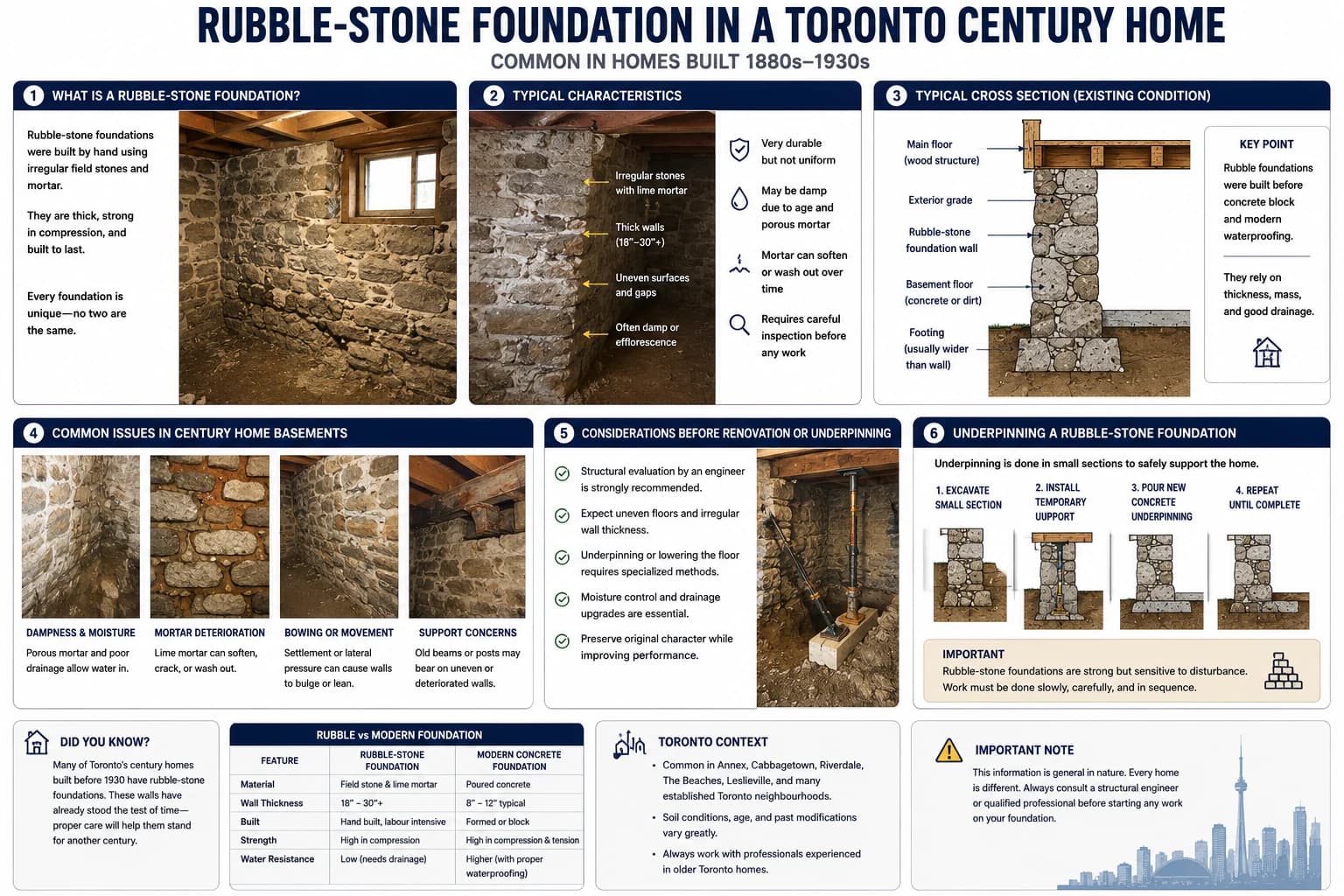
What Is a Rubble-Stone Foundation?
Rubble-stone foundations were built by hand using irregular field stones and lime mortar. They are thick, strong in compression, and built to last. Common in homes built between 1880s–1930s, every foundation is unique — no two are the same.
Common Issues
Dampness
Porous mortar and poor drainage allow water in
Mortar Deterioration
Lime mortar can soften, crack, or wash out
Bowing
Settlement or lateral pressure can cause walls to bulge
Support Concerns
Old beams may bear on uneven or deteriorated walls
Before Renovation — 5 Key Checks
- 1.Structural evaluation by an engineer is strongly recommended
- 2.Expect uneven floors and irregular wall thickness
- 3.Underpinning or lowering the floor requires specialized methods
- 4.Moisture control and drainage upgrades are essential
- 5.Preserve original character while improving performance
Comparison: Rubble-Stone vs Modern Concrete
| Feature | Rubble-Stone | Modern Concrete |
|---|---|---|
| Material | Field stone + lime mortar | Poured/block concrete |
| Wall Thickness | 18"–30"+ | 8"–12" typical |
| Water Resistance | Low (needs drainage) | Higher (with proper waterproofing) |
| Strength | High in compression | High in compression & tension |
| Built method | Hand built, labour intensive | Formed or block |
Toronto Context
Common in Annex, Cabbagetown, Riverdale, The Beaches, Leslieville, and many established Toronto neighbourhoods. Soil conditions, age, and past modifications vary greatly. Always work with professionals experienced in older Toronto homes.
IMPORTANT NOTE
This information is general in nature. Every home is different. Always consult a structural engineer or qualified professional before starting any work on your foundation.
Soil Conditions & Local Challenges
Every Toronto neighborhood has unique geological characteristics that affect underpinning projects.
Soil Conditions
Clay soil with moderate water table. The neighborhood slopes toward the Don Valley to the east, providing generally good drainage compared to flat areas. However, properties on lower slopes or in valley pockets may experience water issues. The mature neighborhood has extensive tree canopy, with root systems that can extend beneath foundations. Soil load-bearing capacity is good, and the sloped topography helps water drain away from foundations naturally, though individual properties vary based on specific grading and lot configuration.
Common Challenges
- Larger home footprints (40-50 feet deep) meaning extensive linear feet of foundation to underpin
- Sloped lots toward Don Valley requiring careful grading, drainage, and potential retaining walls
- Mature trees with extensive root systems requiring arborist consultation and root management
- Higher homeowner expectations for quality, finishes, and minimal disruption in premium homes
- Complex layouts with additions, multiple levels, and structural variations requiring custom engineering
- Party wall considerations for semi-detached homes, some with shared foundations
- Coordination with high-end whole-home renovation projects requiring careful sequencing
Project Scope & Pricing
What to expect for underpinning projects in Riverdale.
Typical Project Scope
Riverdale underpinning projects are typically larger in scope and cost due to home size. Most involve full-perimeter underpinning of semi-detached homes (25-30 feet wide, 35-45 feet deep) or detached homes (30-40 feet wide, 40-50 feet deep) to achieve 7'0"-7'6" ceiling heights. Projects often combine underpinning with comprehensive basement renovations to create high-quality living space, home offices, or legal basement apartments. The larger footprints mean more linear feet of foundation (130-180 linear feet is common), significantly affecting costs. Waterproofing and drainage upgrades are standard. Many Riverdale homeowners pursue underpinning as part of extensive whole-home renovations, reflecting the neighborhood's upscale market.
Pricing Context
Underpinning costs in Riverdale range from $95,000-$150,000 for typical projects — the larger footprints here mean most homes land in the upper half of the typical $75,000-$150,000 range for full basement lowering. Semi-detached homes (25-30 feet wide) average $100,000-$130,000, while larger detached homes (30-40 feet) typically land at $120,000-$150,000. The higher costs reflect larger footprints, more linear feet of foundation, and often higher homeowner expectations for quality. Slope management can add $5,000-$10,000 for retaining walls or grading adjustments. Mature tree root management adds $2,000-$5,000. Despite premium pricing, Riverdale property values ($1.4M-$2.5M) justify the investment. Adding functional basement space or legal apartments increases property value by $160,000-$250,000. The neighborhood's Danforth proximity, parks, schools, and valley views make it extremely desirable.
Frequently Asked Questions
Common questions about underpinning in Riverdale
How does the slope toward the Don Valley affect Riverdale underpinning projects?
The slope toward the Don Valley impacts Riverdale underpinning in several ways. Positively, the slope provides natural drainage away from some foundations, reducing water infiltration risk. However, properties on steeper slopes may require grading adjustments or retaining walls after underpinning to maintain proper drainage patterns and prevent soil erosion. Backyards sloping down may need terracing or retaining walls ($5,000-$12,000 additional cost). Conversely, properties at the bottom of slopes may experience water runoff accumulation, requiring robust drainage systems. During underpinning, excavations on sloped lots require careful shoring to prevent soil movement. The slope also affects access - some properties have walk-out basements or daylight basements on the downhill side, which can simplify excavation access but require different engineering approaches. Overall, the slope is manageable with proper planning and engineering — we account for these considerations from the first walkthrough.
What are the benefits of underpinning a larger Riverdale home versus a smaller home in other neighborhoods?
Underpinning a larger Riverdale home provides substantial benefits due to scale. A typical Riverdale semi-detached home (25-30 feet wide, 40 feet deep) has 1,000-1,200 sq ft of basement space - underpinning creates a massive additional living area equivalent to a full apartment. This space can become a luxurious 2-3 bedroom basement apartment renting for $2,400-$3,000/month, a multi-room in-law suite, or high-quality recreation/office space. The larger footprint means more value added - property value increases by $180,000-$250,000 with proper basement conversion. While underpinning costs are higher ($100,000-$140,000), the cost per square foot is similar to smaller homes, and the total value added is greater. Riverdale property values ($1.4M-$2.5M) support these investments. Additionally, higher-quality original foundations mean fewer surprises and complications. For homeowners with large homes, maximizing basement space is one of the most impactful renovations possible.
How much do mature trees in Riverdale add to underpinning costs?
Mature trees in Riverdale can add $2,000-$8,000 to underpinning costs depending on proximity and tree size. The neighborhood has extensive tree canopy - large street trees (often 60-100 years old) and backyard trees with root systems extending 20-30 feet from trunks. During underpinning, roots near foundations must be managed carefully. We typically work with certified arborists to assess tree health and determine which roots can be pruned without harming trees. Root barriers may be installed to prevent future foundation issues. For very large trees or multiple trees, costs increase. City permits may be required for street tree root pruning ($500-$1,000). Despite added costs, proper tree management is essential - cutting roots improperly can kill trees or cause them to become unstable. Most Riverdale homeowners value their mature trees and are willing to invest in proper management. The benefit is that underpinning, combined with new drainage systems, often improves tree health by managing water better and preventing soil erosion.
Can I create a high-end basement apartment in my Riverdale home after underpinning?
Absolutely, and Riverdale is ideal for high-end basement apartments. After underpinning to achieve 7'6"-8'0" ceilings (higher than standard projects), you can create luxury 2-3 bedroom apartments with modern finishes. The larger Riverdale footprints provide 1,000-1,200 sq ft for spacious layouts, large bedrooms, full kitchens, and quality bathrooms. High-end basement apartments in Riverdale rent for $2,500-$3,200/month to young professionals and families seeking quality rentals near transit, parks, and Danforth restaurants. Beyond rental income, high-end apartments appeal to multigenerational families - many Riverdale homeowners create in-law suites for aging parents or adult children, taking advantage of separate entrance options. Budget $50,000-$85,000 beyond underpinning costs for high-end finishes (engineered hardwood, quartz counters, modern fixtures, quality lighting). The combined investment in underpinning plus finishing is substantial but justified by Riverdale property values and the premium rental/usage these spaces provide.
Is underpinning a good investment for Riverdale homes given the larger project costs?
Yes, underpinning is an excellent investment for Riverdale homes despite higher absolute costs. While projects cost $100,000-$150,000 (more than smaller homes elsewhere), you're gaining 1,000-1,200 sq ft of functional space - the cost per square foot is similar to smaller projects. Property value increases by $180,000-$250,000 with a legal basement apartment, providing strong ROI. For rental income, $2,600/month average generates $31,200 annually, recouping costs in 5-6 years through rental income alone. Beyond financials, underpinning addresses foundation issues in 100+ year old homes and provides peace of mind with modern, code-compliant foundations. Riverdale property values ($1.4M-$2.5M) mean maximizing square footage is essential for investment protection. The neighborhood is one of Toronto's most stable and desirable, with excellent schools, parks (Withrow, Riverdale Park East), and Danforth access. For homeowners planning to stay long-term, underpinning is one of the most valuable renovations possible, transforming unusable cellar space into premium living area.
Related Resources
Explore more about underpinning in Toronto
Best Underpinning Services in Toronto
How we run underpinning projects across Toronto — our crew, our methods, and what every job includes.
Complete Underpinning Process Guide
Step-by-step visual guide to understanding the underpinning process from start to finish.
Underpinning Costs in Toronto
Detailed cost breakdown and pricing factors for underpinning projects in the Toronto area.
Underpinning vs Bench Footing
Compare foundation lowering methods and determine which approach is right for your project.
Ready to Start Your Underpinning Project in Riverdale?
We know Riverdale's housing stock and soil conditions. Book a free walkthrough — no obligation — and follow every step of the work in our live client app.
Licensed & Insured
WSIB covered, fully insured, and licensed under the OBC
Local Expertise
Familiar with Riverdale's soil conditions and building requirements
Live Client App
Crew, costs, photos and inspections visible on every project