
Underpinning in The Annex, Toronto
Foundation underpinning specialists for The Annex heritage Victorian and Edwardian homes
Housing Profile: The Annex
Understanding your neighborhood's unique housing characteristics is essential for proper underpinning planning.
Housing Stock
The Annex is one of Toronto's most architecturally significant neighborhoods, featuring predominantly Victorian and Edwardian homes built between 1880-1920. The housing stock includes large detached and semi-detached homes with distinctive architectural styles: Second Empire, Queen Anne Revival, Romanesque Revival, and Edwardian Classical. Many homes are 2.5 to 3 storeys with bay windows, decorative brickwork, and high-quality craftsmanship. The neighborhood was developed for upper-middle-class professionals and academics (proximity to University of Toronto), resulting in larger homes on relatively wide lots (25-35 feet) compared to working-class neighborhoods. Many homes have heritage designations or are within heritage conservation districts.
Era Range
1880s-1920s (Victorian and Edwardian era)
Foundation Types
Primarily rubble stone foundations (1880s-1910s) with lime mortar, transitioning to early poured concrete and brick foundations in later Edwardian homes (1910s-1920s). Some of the oldest homes have fieldstone foundations without proper footings by modern standards. Many foundations show evidence of multiple repair campaigns over 100+ years, with patches of concrete added to original stone. The quality varies significantly - some high-end homes have remarkably well-constructed stone foundations, while others show signs of settlement and deterioration.
Typical Ceiling Height
5'6" to 6'2" - The Annex has notably low basement ceiling heights despite the homes being larger and higher-quality overall. Victorian homes (1880s-1890s) often have basement heights as low as 5'6"-5'10", with Edwardian homes (1900s-1920s) typically in the 5'10"-6'2" range. The low ceilings reflect 19th-century standards where basements were truly cellars for coal storage and furnaces, not living space. This makes underpinning highly desirable for homeowners seeking to maximize their substantial homes.
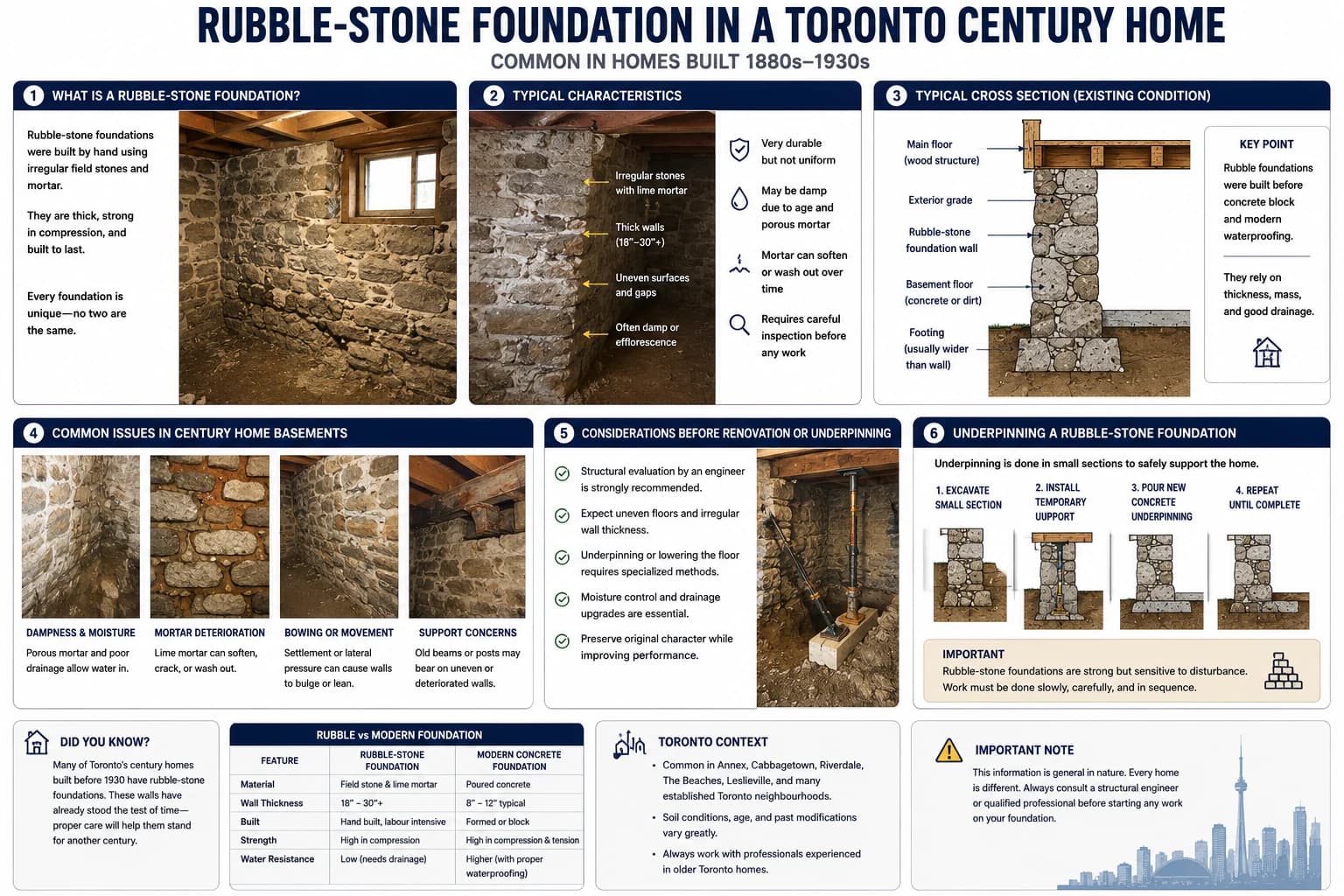
What Is a Rubble-Stone Foundation?
Rubble-stone foundations were built by hand using irregular field stones and lime mortar. They are thick, strong in compression, and built to last. Common in homes built between 1880s–1930s, every foundation is unique — no two are the same.
Common Issues
Dampness
Porous mortar and poor drainage allow water in
Mortar Deterioration
Lime mortar can soften, crack, or wash out
Bowing
Settlement or lateral pressure can cause walls to bulge
Support Concerns
Old beams may bear on uneven or deteriorated walls
Before Renovation — 5 Key Checks
- 1.Structural evaluation by an engineer is strongly recommended
- 2.Expect uneven floors and irregular wall thickness
- 3.Underpinning or lowering the floor requires specialized methods
- 4.Moisture control and drainage upgrades are essential
- 5.Preserve original character while improving performance
Comparison: Rubble-Stone vs Modern Concrete
| Feature | Rubble-Stone | Modern Concrete |
|---|---|---|
| Material | Field stone + lime mortar | Poured/block concrete |
| Wall Thickness | 18"–30"+ | 8"–12" typical |
| Water Resistance | Low (needs drainage) | Higher (with proper waterproofing) |
| Strength | High in compression | High in compression & tension |
| Built method | Hand built, labour intensive | Formed or block |
Toronto Context
Common in Annex, Cabbagetown, Riverdale, The Beaches, Leslieville, and many established Toronto neighbourhoods. Soil conditions, age, and past modifications vary greatly. Always work with professionals experienced in older Toronto homes.
IMPORTANT NOTE
This information is general in nature. Every home is different. Always consult a structural engineer or qualified professional before starting any work on your foundation.
Soil Conditions & Local Challenges
Every Toronto neighborhood has unique geological characteristics that affect underpinning projects.
Soil Conditions
Sandy clay soil with moderate drainage. The Annex sits on relatively high ground with gentle slopes toward Taddle Creek (now buried and part of the sewer system). Soil conditions are generally favorable for underpinning, with decent load-bearing capacity and less severe clay composition than some Toronto neighborhoods. However, the buried Taddle Creek can create localized drainage challenges, and some properties experience groundwater infiltration. Overall, The Annex has better soil conditions than low-lying areas near Lake Ontario or the Don Valley.
Common Challenges
- Heritage designation requirements necessitating Toronto Heritage Preservation Services approval and documentation
- Rubble stone foundations with deteriorated lime mortar requiring careful restoration and reinforcement
- Very low basement ceiling heights (5'6"-6'0") requiring extensive excavation depth
- Complex layouts with multiple additions, rooms, and structural variations requiring custom engineering
- Large home footprints (40-50 feet deep) meaning extensive linear feet of underpinning
- Buried Taddle Creek and historical watercourses creating localized drainage issues
- High homeowner expectations for quality finishes and minimal disruption in prestigious properties
Project Scope & Pricing
What to expect for underpinning projects in The Annex.
Typical Project Scope
Annex underpinning projects are typically more complex and expensive than average Toronto projects. Most involve full-perimeter underpinning to increase ceiling height from 5'8"-6'0" to 7'0"-8'0", creating usable basement space in very large homes (2,000-3,500+ sq ft total). Projects often include foundation restoration (repointing rubble stone, stabilizing deteriorated sections), comprehensive waterproofing, and drainage upgrades. Many homeowners combine underpinning with basement renovations to create high-end living space, home offices, or rental units. Heritage approvals add planning time. The large footprints of Annex homes mean more linear feet of foundation to underpin, significantly increasing costs.
Pricing Context
Underpinning costs in The Annex sit at the top of Toronto's typical $75,000-$150,000 range for full basement lowering, with most projects landing between $110,000-$150,000 all-in (of that, roughly $5,000-$12,000 goes to engineering and permits). Full-perimeter underpinning for large detached homes (30-35 feet wide, 40-50 feet deep) typically lands at $130,000-$150,000. Heritage home considerations, complex layouts, and rubble stone foundation restoration push Annex projects toward the upper end of the range. However, Annex property values ($1.8M-$4M) justify the investment. Adding legal basement apartments or high-quality living space increases property value by $180,000-$300,000. The neighborhood's prestige, walkability, and proximity to U of T make it one of Toronto's most desirable locations.
Frequently Asked Questions
Common questions about underpinning in The Annex
Do I need heritage approval to underpin my home in The Annex?
It depends on your property's designation. Many Annex homes are individually designated under the Ontario Heritage Act or fall within the Annex Heritage Conservation District. If your home is designated, you need approval from Toronto Heritage Preservation Services before proceeding with underpinning. The process involves submitting engineering drawings, structural reports, and documentation showing that the work won't compromise heritage features. Since underpinning is done entirely below grade and doesn't affect exterior facades or architectural details, approvals are usually granted. Processing takes 4-8 weeks. We have experience with heritage approvals and coordinate the documentation with your structural engineer. If your home is not designated, no heritage approval is required, but you still need standard building permits. Check the City of Toronto's heritage register or consult with Heritage Preservation Services to confirm your property's status.
What makes underpinning Victorian rubble stone foundations different from modern foundations?
Victorian rubble stone foundations in The Annex are fundamentally different from modern poured concrete. They consist of irregularly shaped stones (rubble) mortared together with lime mortar, often without proper footings by today's standards. The lime mortar deteriorates over 100+ years, causing stones to loosen and water infiltration. During underpinning, we must carefully excavate around rubble stone, as it's more fragile than concrete. We typically reinforce the existing stone with shotcrete or new concrete backing, then pin new underpinned footings securely to the reinforced stone. The process requires specialized expertise - mistakes can cause stone sections to collapse. Engineering oversight is mandatory. While more complex than underpinning concrete, rubble stone foundations can be successfully underpinned. Many Annex homes have undergone this process with excellent long-term results.
How much does it cost to underpin a large Victorian home in The Annex?
Large Victorian homes in The Annex (30-35 feet wide, 40-50 feet deep) require budgets of $130,000-$150,000 for full-perimeter underpinning — the very top of the typical $75,000-$150,000 range for full basement lowering. The high cost reflects several factors: large footprints mean 140-170 linear feet of foundation to underpin; rubble stone foundations require reinforcement and careful handling; very low existing ceiling heights (often 5'6"-5'10") require excavating 18-24 inches deeper than standard projects; heritage approvals add engineering and documentation costs; complex layouts with additions and multiple foundation sections increase complexity. For Annex homeowners, the investment is justified by property values ($1.8M-$4M) and the value added ($180,000-$300,000 for creating functional basement space or legal apartments). Many homeowners finance underpinning through refinancing or HELOCs, with rental income from basement apartments covering financing costs.
Can I create a basement apartment in my Annex home after underpinning?
Yes, and it's a very common goal for Annex underpinning projects. After underpinning to achieve 7'0"+ ceiling height, your basement can be converted to a legal second unit under Toronto's second suite bylaws. The Annex location is extremely desirable for renters (U of T students, professionals, academics), and 2-bedroom basement apartments rent for $2,200-$3,000/month. However, consider several factors: separate entrance requirements (exterior door meeting setback requirements); fire separation between units (fire-rated ceiling, walls, and doors); sound insulation to maintain privacy; egress windows for bedrooms meeting minimum size requirements; kitchen and bathroom installations meeting plumbing codes. Budget $40,000-$70,000 beyond underpinning costs for apartment finishing. Despite the investment, rental income of $2,500/month generates $30,000/year, providing strong ROI. Many Annex homeowners pursue this to offset mortgage costs or accommodate extended family.
Why are basement ceiling heights so low in Annex Victorian homes despite the homes being high-quality?
This reflects 19th-century building practices and the function of basements in Victorian times. From the 1880s-1900s, basements were not considered living space - they were utilitarian cellars for coal storage, furnaces, root vegetables, and laundry. Living happened on the main floors above. Builders minimized excavation depth to reduce construction costs and structural complexity. Additionally, Victorian homes have very high main floor ceiling heights (9-10+ feet) and often tall foundations above grade, so the overall home height is substantial - basements were simply not prioritized. By the Edwardian era (1900s-1920s), ceiling heights improved slightly (6'0"-6'2"), but still below modern standards. Today, given Annex property values and the desirability of maximizing square footage, underpinning to create functional basement space is one of the most valuable renovations you can undertake. It transforms wasted cellar space into premium living area in one of Toronto's most prestigious neighborhoods.
Related Resources
Explore more about underpinning in Toronto
Best Underpinning Services in Toronto
How we run underpinning projects across Toronto — our crew, our methods, and what every job includes.
Complete Underpinning Process Guide
Step-by-step visual guide to understanding the underpinning process from start to finish.
Underpinning Costs in Toronto
Detailed cost breakdown and pricing factors for underpinning projects in the Toronto area.
Underpinning vs Bench Footing
Compare foundation lowering methods and determine which approach is right for your project.
Ready to Start Your Underpinning Project in The Annex?
We know The Annex's housing stock and soil conditions. Book a free walkthrough — no obligation — and follow every step of the work in our live client app.
Licensed & Insured
WSIB covered, fully insured, and licensed under the OBC
Local Expertise
Familiar with The Annex's soil conditions and building requirements
Live Client App
Crew, costs, photos and inspections visible on every project